Six AI bots run by X now dominate automated Community Notes. Here is how the system works and how to verify the context they provide.
This article was researched and drafted with AI, then checked and released by a person before it went live. The illustration is AI-generated. Every factual claim links to its source, so you can verify it yourself.
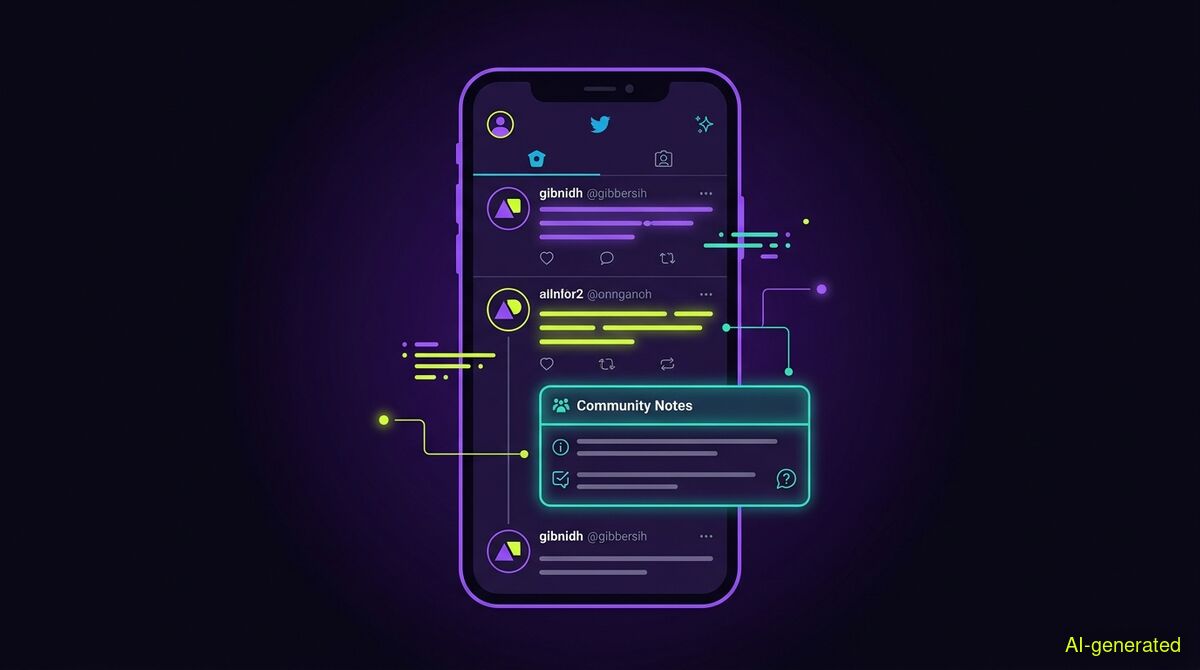
AI-generated illustration. A phone screen displaying a social media timeline with a context box attached beneath a post.
Six automated accounts run by X itself generate the majority of successful AI written Community Notes, acting as predictors for what human raters will find helpful. Because most notes remain unrated and delayed, a note is just one dated input rather than a final verdict. Readers must still verify the primary sources behind the provided context.
When people search for ai written community notes online, they are often surprised to learn how heavily automated the system has become. X originally built its context system around human volunteers proposing and rating corrections. Today, automation is deeply integrated into the pipeline, fundamentally changing how context is generated on the platform.
Understanding who writes these notes and how they reach your timeline is essential for anyone relying on them to verify breaking news or viral claims. A note is a highly useful piece of context, but the mechanics behind it dictate that it should be treated as a starting point rather than a final verdict.
In September 2025, X opened an AI Note Writer API. This provided a public interface for machines to propose context on posts. Since then, the volume of automated submissions has grown significantly, but the sources of those submissions are highly concentrated.
As Renée DiResta reported in October 2026 regarding her own work building a fact-checking bot, the landscape is dominated by internal accounts. She and Alexios Mantzarlis found that six AI notewriters run by X itself produced about 90 percent of AI-bot submissions and about 55 percent of successful AI-written notes last month. These figures represent their exact scope among AI notewriters for that single month, not a share of all notes on the platform.
These bots do not simply generate text at random. In a recent technical report, the Community Notes team explained that their AI system uses explicit note requests and user posts to determine its feeds. The algorithms are designed to predict which notes human raters will find helpful and skip the rest. The AI acts as an accelerator, drafting context that matches the established preferences of the human rating community.
While bots can write notes at scale, they cannot publish them directly to the timeline. Every proposed note, whether written by a human or an AI, enters a holding phase where it is invisible to regular users. It only becomes public if it receives enough helpful ratings from contributors who typically disagree on past ratings.
Because of this strict consensus requirement, the vast majority of proposed context never appears. X-Autopilot detailed that 87.7 percent of proposed notes stay in the rating phase permanently. Similarly, a 2026 study on health misinformation found that 87.9 percent of notes remain unrated.
The requirement for cross-perspective agreement also creates a significant time lag. The same health misinformation study measured a median delay of 17.6 hours for a note to receive its first helpful verdict. During a fast-moving news event, a viral post will often circulate for a full day before any community context is attached to it.
This design makes the system highly resilient to manipulation by single factions, but it also limits its speed and coverage. As Chris Slowe noted, Community Notes is one layer in a governance stack, and the industry is increasingly mistaking the layer for the whole architecture. The appeal is a clean, neutral, and scalable story without editorial staff.
However, relying entirely on this layer means waiting for consensus. When a note does appear, it is one dated input. It provides links and context that the community agreed was helpful at that specific moment. It does not replace the need to check the primary sources directly.
When you encounter a Community Note, the most reliable approach is to treat it as a sourced correction and verify the underlying evidence. If you want to check a claim immediately without waiting for community consensus, you can paste a post URL into the free wyper web app to run a standard check. wyper reads the note on an X post, treats it as another input, and checks the primary sources.
The tool returns a truth score of 1-10 plus an evidence chain of real, linked sources. Sources are never filtered by origin. There is no mainstream bonus and no preference for official sources. The reader decides what to trust, and the tool never claims to judge the intent behind a post.
The standard check uses a Dual-AI cross-check. This runs on Gemini and Grok, and Grok searches for itself there so the two do not share one evidence set.
For deeper analysis, the Full Spectrum tier provides a Triple-AI reading: three models, one evidence set. The third voice does not search. It receives exactly the sources the main model received and reads them independently. This means a disagreement is a different reading of the same material, not a different search result.
Our own published measurements highlight why reading the same sources matters. Two models trained on overlapping text are correlated, not independent. In our tests with frozen sources, Gemini and Grok agreed in 29 of 29 claims, even on deliberately contested topics. Because they overlap so heavily, confirmation by two models carries little information. However, a third model of different origin disagreed in 3 of 26 cases, every time with a machine-verified quote. This is the strongest signal we have, and it argues against claims we used to make ourselves.
When fetching evidence, we reached 63 percent primary sources and 14 percent legacy media in a test of 24 claims with the root named in advance. For quote checking across 633 real citations, we found 73 percent verbatim on the page. We also found that 19 percent of pages were unreachable for automated readers due to paywalls or PDF formats, and 6.4 percent were not findable.
To maintain transparency, wyper maintains a public dispute register. This register is append-only and hash-chained, meaning entries cannot be silently edited or removed.
When you need to verify a post on X, you have different routes available depending on your privacy needs and how deeply you want to investigate.
| Feature | Manual checks | wyper web app | wyper extension |
|---|---|---|---|
| Cost | Free | Free tier available | Free tier available |
| Setup | Nothing installed | No install or signup | Browser extension required |
| Privacy | Total privacy, no data leaves the browser | Sends post URL to wyper servers | Sends checked claims to wyper servers |
| Fact-checking | You read every source yourself | Truth score 1-10 with evidence | Truth score 1-10 with evidence |
| Video subtitles | Manual transcript search | Cannot see YouTube session | Reaches active browser session |
Who needs which: Manual checks are best for users who refuse to send any data to external servers and have the time to read through multiple search results themselves. The wyper web app is built for users who want a fast, free evaluation of a specific post URL without installing any software or creating an account. The wyper extension is designed for researchers and heavy readers who want to verify claims, posts, and videos directly where they read them, utilizing their active browser session to reach subtitles that external apps cannot see.
Automated accounts now draft a significant portion of the successful context on X, acting as predictors for what human raters will approve. Because the human rating bottleneck delays most notes and filters out nearly 87 percent of them, a note is best treated as a single sourced input. Readers must still take the final step of verifying the primary evidence themselves.
The wyper Fact-Check extension runs these checks on the post itself: truth score, evidence chain, and the date gap that catches recycled footage.
The web app installs to your home screen in one tap. No store, no account.
Already using it? ★★★★★ Rate it on the Chrome Web Store. Reviews decide what others get shown first.
 wyper