A broadcast logo proves nothing. Learn how to verify news clips using original sources, broadcast dates, and subtitle comparison to spot manipulated video.
This article was researched and drafted with AI, then checked and released by a person before it went live. The illustration is AI-generated. Every factual claim links to its source, so you can verify it yourself.
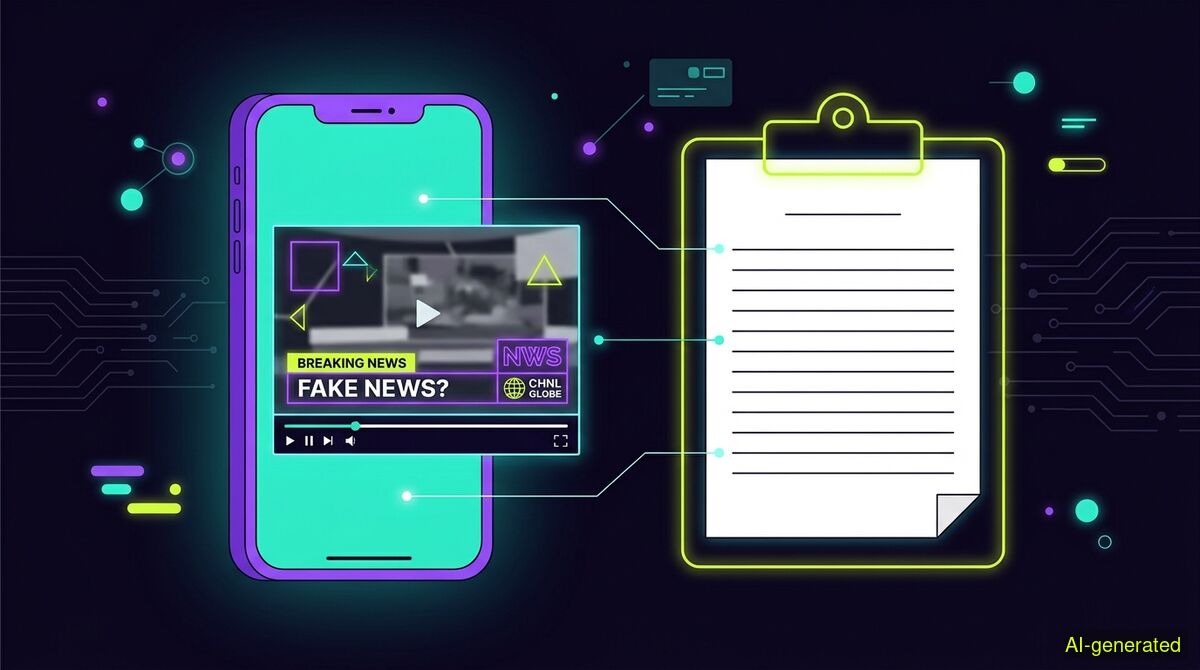
AI-generated illustration. A smartphone screen showing a video player with a news network overlay being compared to a blank transcript document.
To spot a manipulated news broadcast, you must ignore the logo and trace the footage back to the network's own official archive. Bad actors routinely paste trusted logos over stolen or altered clips to bypass your critical thinking. By checking the original broadcast date, cross-referencing subtitles, and verifying the earliest publication, you can confirm whether a newsroom actually aired the segment.
Seeing a fake cnn video logo on your social media feed is becoming a daily hazard. A broadcast logo is entirely meaningless when viewed outside of a network's official channels. It is just a transparent image file. Anyone with basic editing software can download a news logo and drop it over their own footage in seconds.
In September 2026, NBC News reported on a Russian disinformation operation known as Matryoshka. The campaign specifically targeted the United States midterms by doctoring videos of Hollywood actors. To make these clips look like legitimate news packages, the operators branded them with a fake CNN logo. Viewers scrolling quickly saw a familiar red and white box and assumed a trusted newsroom had vetted the material. You cannot rely on visual branding to prove authenticity. You have to verify the origin of the clip, the broadcast date, and the actual words spoken.
The Matryoshka campaign illustrates exactly how simple this deception is. AFP Fact Check found that the operation unleashed a series of videos across social media using hashtags like "#AllDemocratsAreCriminals". These videos showed celebrities purportedly chastising the Democratic Party. The clips were heavily manipulated. As the PropagandaArchive documented, the network reused harmless Cameo clips and replaced the original audio with cloned voices.
The final touch was the stolen CNN mark. The creators knew that social media algorithms reward immediate engagement. If a user stops to question the video, the deception fails. The network logo acts as a mental shortcut for the viewer. It signals that a professional editorial team has already checked the facts, allowing the viewer to lower their guard.
The most definitive way to check a broadcast clip is to look for it at the source. If CNN, the BBC, or Fox News actually aired a segment, they have a digital record of it. Major networks publish their broadcasts, transcripts, and highlight clips on their own verified websites and official YouTube channels.
When you see a suspicious clip, pick a distinct quote from the video. Type that exact phrase into a search engine alongside the name of the network. You can also test basic text claims by pasting a quote into the free wyper web app to see if a real newsroom ever published those words. If a high-profile celebrity gave a shocking political statement on a major cable network, multiple legitimate news outlets would write about it immediately. If your search returns nothing but social media posts and obscure blogs, the broadcast is almost certainly fake.
Manipulating video is time-consuming, but replacing audio is incredibly fast. Bad actors frequently take genuine footage of a news anchor speaking and swap the audio track with an AI voice clone.
You can combat this by checking the transcript. As TVEyes explains, finding a specific broadcast media clip relies heavily on indexing audiovisual content through highly accurate transcriptions. When checking a video manually, look for closed captions. If the video has hardcoded subtitles that look slightly off-center or use a non-standard font, be suspicious.
Fact-checking tools handle this by reading the text directly. The wyper extension uses subtitles whenever they are reachable on the page. When subtitles are missing, an AI model actually watches the video within a specific time window. The free tier covers up to 10 minutes on YouTube and 2 minutes on X, while the Pro tier covers 30 minutes on YouTube and 7 minutes on X. Longer videos are refused outright rather than being partially checked.
The most common form of video deception does not involve deepfakes or cloned audio. It involves taking completely real, unaltered footage from years ago and claiming it happened today. A pixel detector cannot see this lie at all, because the pixels are genuine.
Professional newsrooms focus heavily on the date gap. Storyful notes that their verification process involves comparing the purported date of filming with reports from official sources and local reporting. They confirm the footage is what it claims to be, exactly when it claims to be.
This is why verifying the earliest documented publication is critical. When the AI Spotter tool analyzes a video, it takes still frames and searches each one separately to find the earliest appearance on the internet. What carries the real weight for video verification is the event-versus-post date gap. If a clip labeled "Breaking News 2026" first appeared on a forum in 2022, the logo on top of it does not matter. The context is fake.
The technology industry has tried to solve this problem by attaching digital signatures to media files. The Coalition for Content Provenance and Authenticity (C2PA) created a standard to track the origin of a file. As TV Tech reported, newsrooms must now grapple with proving the process by which a clip reached the edit, and whether the version viewers see still matches the original material.
However, content credentials have a massive limitation on social media. A C2PA signature sits in its own box beside the picture data. Any repackaging drops it completely, even a lossless compression that leaves every pixel untouched. Social media platforms automatically repackage video files upon upload to save bandwidth.
Therefore, on a video taken off a social media feed, the provenance layer will almost always find nothing. This is the normal case, not a suspicion. If you want to check a digital signature, you have to find the original file before the platform compressed it.
| Feature | Manual checks | wyper web app | wyper extension |
|---|---|---|---|
| Text fact-checking | Free | Free tier (5 checks daily) | Free tier (5 checks daily) |
| Video subtitle access | Requires manual search | Often unavailable for YouTube | Reads subtitles automatically |
| Direct AI video watching | None | Paid AI Spotter (4 credits) | Yes (time window limits apply) |
| C2PA signature check | Needs external tools | Paid AI Spotter only | Paid AI Spotter only |
| Privacy and access | Stays strictly in your browser | Requires pasting a link | Runs directly in your active tab |
Who needs which: Manual checks are ideal for readers who want complete privacy, as the verification process happens entirely in your own head and browser without relying on any third-party tools. The wyper web app suits users on mobile devices or public computers who need to quickly verify a specific text quote without installing anything. The wyper extension is built for heavy social media users who want to check videos directly in their feed, leveraging automated subtitle reading and in-tab analysis.
A broadcast network logo on a social media video is just a string of pixels that anyone can add to a clip. To spot a fake, you must ignore the visual branding and trace the footage back to the network's official archive. Verifying the original broadcast date and checking the exact subtitles will quickly expose manipulated propaganda.
The wyper Fact-Check extension runs these checks on the post itself: truth score, evidence chain, and the date gap that catches recycled footage.
The web app installs to your home screen in one tap. No store, no account.
Already using it? ★★★★★ Rate it on the Chrome Web Store. Reviews decide what others get shown first.
 wyper