When AI models evaluate claims, they often reach different conclusions. We explain why training data, source selection, and reading methods cause friction.
This article was researched and drafted with AI, then checked and released by a person before it went live. The illustration is AI-generated. Every factual claim links to its source, so you can verify it yourself.
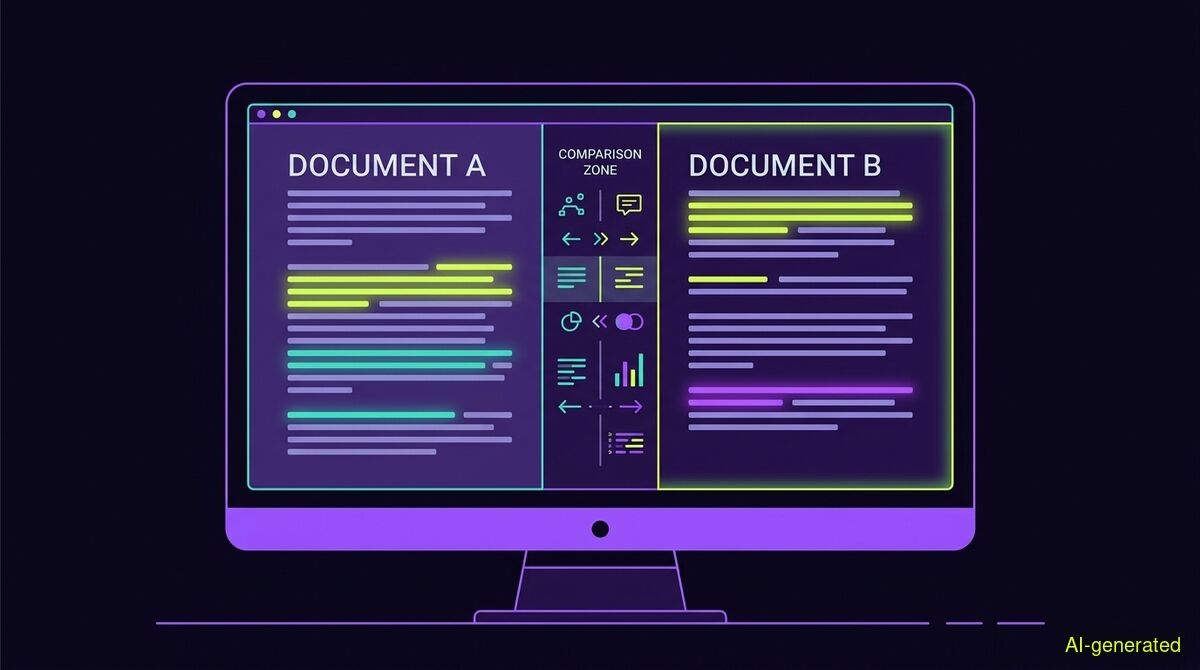
AI-generated illustration. A split computer monitor displaying two different text documents side by side with highlighted paragraphs and a central comparison column.
AI models disagree on a fact-check because they find different sources, interpret texts differently, or rely on conflicting training data. True disagreement surfaces when models with different architectures read the exact same evidence set, highlighting nuances that a single model might miss.
If you ever encounter an AI models disagree fact-check report, the immediate question is why two advanced systems reach opposing verdicts on the exact same claim. Many users assume that artificial intelligence operates like a calculator, where a specific input always yields a single objective output. In reality, evaluating a claim requires searching for external evidence, selecting which sources to trust, and interpreting nuanced human language. When models diverge, they are exposing the messy reality of how information is recorded and debated on the internet.
A common assumption is that if two different AI models confirm a story, the story must be true. This is mathematically flawed. Modern language models are trained on massive, overlapping datasets. They have read the same internet archives, the same encyclopedias, and the same news repositories. Because of this shared foundational data, their outputs are highly correlated rather than truly independent.
In our own published measurements, we tested Gemini and Grok on 30 claims using frozen sources. The two models agreed in 29 out of 29 completed cases. This near-total agreement happened even on deliberately contested claims. When two models are correlated by their training data, the phrase "confirmed by two AIs" carries very little actual information. They are simply repeating the consensus of their overlapping text weights. Agreement is not a stamp of quality or a proof of truth.
When models do diverge during an active investigation, the most common reason is the search phase. If a model is allowed to browse the live internet, the specific keywords it chooses will dictate the articles it finds.
Our standard check utilizes a Dual-AI cross-check featuring Gemini plus Grok. Grok searches for itself there, meaning the two do not share one evidence set. Because they run independent searches, they frequently retrieve different primary sources, different news reports, or different historical records. If one model finds a primary data table and the other finds a heavily editorialized opinion piece about that data, their final verdicts will naturally differ. The disagreement is not about logic. It is purely about the inputs they gathered.
Finding a source is only the first step. The model must then accurately extract quotes to build an evidence chain. In a test of 633 real citations re-fetched by our system, 73 percent were found verbatim on the page. However, 19 percent of pages were unreachable for automated readers due to 403 errors, PDFs, or paywalls, and 6.4 percent were simply not findable. If one model hits a paywall and another finds an open-access summary, their available facts immediately split.
The most revealing scenario happens when models read the exact same text but draw different conclusions. This is where architectural differences actually matter.
For deep investigations, the Full Spectrum mode uses a Triple-AI reading: three models, one evidence set. The third voice does not search. It receives exactly the sources the main model received and reads them independently. When a disagreement occurs here, it represents a fundamentally different reading of the same material, not a different search result.
This method produces genuine friction. In our testing, a third model of different origin disagreed in 3 of 26 cases. Every single time it disagreed, it provided a machine-verified quote from the text to back up its opposing view. Disagreement from a different architecture, reading the same text, is the strongest signal we have that a claim is highly nuanced or poorly defined.
Academic research supports the value of this friction. A study published by Lenz Research tested five frontier models on 1,000 real-world claims submitted to a fact-checking platform. The researchers found that the models were not unanimous 63 percent of the time. They frequently split on their verdicts, proving that frontier models are not simply interchangeable judges.
Another paper on multi-LLM knowledge graph verification explored this dynamic in detail. The researchers found that ensemble conflict signals epistemic uncertainty. When models disagree, it usually points to a claim that is genuinely ambiguous or subject to conflicting evidence in the real world. Single models suffer from systematic flaws like verbosity bias, where they favor longer answers, and acquiescence bias, where they agree with the user's premise. Pitting different architectures against each other helps expose these blind spots.
Even when provided with good evidence, models struggle to apply it perfectly. A study on evidence-grounded fact-checking noted that while models have strong reasoning capabilities, it remains unclear whether they faithfully make use of the evidence provided. Furthermore, evaluation tools themselves have known limits. A 2026 paper examining factuality evaluation methods warned that the reliability of these automated judges remains underexplored.
Video claims introduce another layer of complexity. The extension uses subtitles when they are reachable. When subtitles are not available, an AI model actually watches the video within a specific time window. This limit is 10 minutes on the free tier and 30 minutes on Pro for YouTube. For X videos, the limit is up to 2 minutes free and 7 minutes Pro. Longer X videos are refused outright rather than partially checked. The system extracts the claims made in the video and checks them against external evidence. It does not run deepfake pixel forensics.
Whenever video comes up, it is important to distinguish fact-checking from visual provenance. The AI Spotter tool, available only in the web app on paid plans, generates a provenance report rather than a text fact-check. It checks content credentials against 55 official trust anchors. A content credential sits in its own box beside the picture data. Any repackaging drops it, including a lossless one that leaves every pixel untouched. Platforms repackage files on upload. Therefore, on a video taken off a social feed, that layer will almost always find nothing. This is the normal case, not a suspicion, and the report says so. We advise checking the original file instead, where the signature can still be intact. What carries the real weight for video is the earliest appearance date plus the event-versus-post date gap. That catches the most common deception: old footage relabelled as new.
You can test how different tools handle claims by using the free wyper web app or installing the browser extension. The table below outlines how these approaches compare to manual research.
| Feature | Manual checks | wyper web app | wyper extension |
|---|---|---|---|
| Cost | Free | Free tier available | Free tier available |
| Installation | None required | None required | Browser extension required |
| Privacy | Data stays in browser | Requires sending claim | Operates in active tab |
| Evidence gathering | User searches manually | Automated search | Automated search |
| Video subtitles | User reads manually | Cannot access YouTube session | Reads active session subtitles |
Who needs which: Manual checks are best for users who want total privacy and have the time to read multiple primary sources themselves. The wyper web app is ideal for quick text checks on a mobile device or a work computer where extensions are blocked. The wyper extension is built for heavy researchers who need to check long YouTube videos, bypass basic subtitle blocks using their active browser session, and see evidence chains right next to their social media feeds.
AI models disagree on fact-checks because they find different sources, interpret language differently, and possess conflicting training data. True disagreement is highly valuable, as it highlights nuances and ambiguities that a single model will typically gloss over. A truth score is never a substitute for reading the underlying evidence chain.
The wyper Fact-Check extension runs these checks on the post itself: truth score, evidence chain, and the date gap that catches recycled footage.
The web app installs to your home screen in one tap. No store, no account.
Already using it? ★★★★★ Rate it on the Chrome Web Store. Reviews decide what others get shown first.
 wyper
wyper