ChatGPT Atlas summarizes content and navigates pages, but does it verify claims? Compare AI browsers against dedicated fact-checking tools.
This article was researched and drafted with AI, then checked and released by a person before it went live. The illustration is AI-generated. Every factual claim links to its source, so you can verify it yourself.
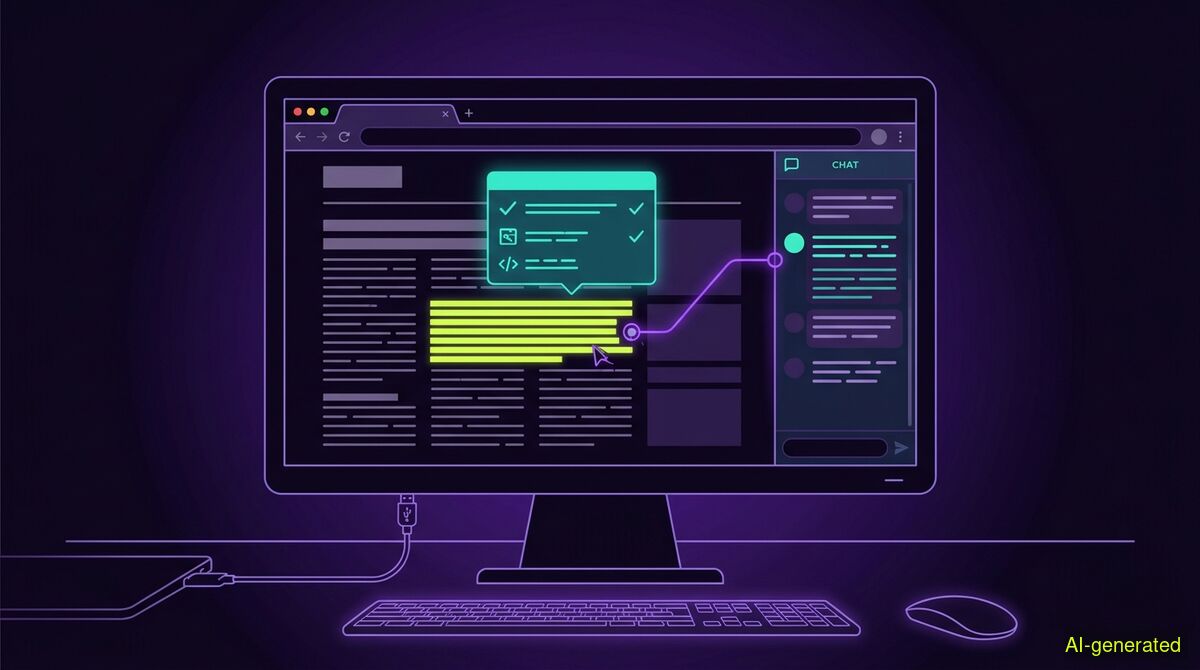
AI-generated illustration. A desktop monitor displaying a web browser with a sidebar chat panel next to a news article, with highlighted text and a source verification tooltip hovering above it.
ChatGPT Atlas cannot independently fact-check what you read because its agent mode summarizes the current page rather than cross-referencing claims against external primary sources. While the browser excels at automating tasks and organizing information, verifying truth requires specialized tools that fetch citations and verify direct quotes.
When researching a complex topic or reading breaking news, you might expect a chatgpt atlas fact check to instantly verify the claims on your screen. The integration of artificial intelligence directly into the browser interface promises to change how we interact with information. However, there is a fundamental difference between an assistant that can read a webpage for you and a verification tool that can prove whether the text on that page is actually true.
To understand what AI browsers can and cannot do, we have to look at how they retrieve information and how they present their findings. A tool designed to summarize text operates under very different rules than a system built to cross-reference evidence.
OpenAI introduced ChatGPT Atlas in October 2025 as a new web browser built with its popular chatbot at the core. As Reuters reported, the launch marked a direct challenge to the dominance of Google Chrome by integrating AI features directly into the daily browsing experience. The software aims to act as a super-assistant that understands your context and helps you achieve goals without leaving the page.
One of the most heavily discussed features is the agent mode. When Ars Technica tested this capability, they found that it could ably automate web-based tasks by clicking, scrolling, and reading through various tabs. Simon Willison highlighted another major feature called browser memories, which allows the AI to remember key details from your browsing history to improve chat responses and retrieve previously read pages.
These features make the browser highly effective at workflow automation and content summarization. If you need a long article condensed into three bullet points, the browser can do that instantly. But summarization relies entirely on the premise that the source text is accurate.
The core problem with using a general AI assistant for verification is that it defaults to providing a helpful answer rather than a cautious one. When you ask a standard language model if a claim in an article is true, it often just reads the page back to you or searches its own training data to generate a plausible response.
A 2026 study published in the ACM SIGIR conference uncovered hidden risks in well-structured AI search summaries. The researchers noted that these summaries are typically citation-rich and create a strong appearance of reliability. This structure encourages user trust even when the evidential grounding of the answer is highly uncertain. The model prioritizes giving you an answer first, while treating the underlying evidence as a secondary concern.
Another study presented at FAccT 2025 examined search engines in the AI era and warned of the false promise of factual and verifiable source-cited responses. Answer engines are fundamentally changing how people access information by generating summaries rather than returning relevant links. When the browser acts as a middleman that reads the internet for you, it filters out the context that human readers normally use to judge the credibility of a source.
Even when AI search tools attempt to fetch external evidence, they often fail to use it correctly. Researchers at Imperial College London evaluated search-augmented models to understand why they sometimes produce outdated answers even when relevant evidence is available online. They found that models frequently answer from short search snippets without ever opening the source pages. This shortcut is associated with higher rates of outdated answers and unfaithful citations.
This dynamic harms both the user and the original publishers. The Columbia Journalism Review tested several AI search engines and found a troubling imbalance. While traditional search engines guide users to news websites, generative search tools parse and repackage the information themselves. This cuts off the traffic flow to the original sources that actually did the reporting.
Furthermore, these systems suffer from severe biases in what they choose to cite. Researchers at the University of Illinois examined 11,000 real search queries across multiple generative search systems. They discovered significant source-selection biases, meaning the AI creates information bubbles based on its own hidden preferences rather than showing the user a neutral cross-section of available evidence.
A dedicated verification tool approaches the internet differently than a general AI assistant. Instead of trying to answer your question directly, it searches for primary sources, retrieves the actual text from those pages, and checks if the claims match the evidence. You can test this text verification process using the free wyper web app without installing any software or creating an account.
Wyper returns a truth score of 1-10 alongside an evidence chain of real, linked sources. The sources are never filtered by origin, meaning there is no mainstream bonus and official sources are not automatically preferred. The system simply presents the evidence so the reader can decide.
The standard check relies on a Dual-AI cross-check powered by Gemini and Grok. Because Grok searches for its own information during this process, the two models do not share one single evidence set.
For users who require a deeper analysis, the Full Spectrum tier provides a Triple-AI reading. This full spectrum option uses three models to evaluate one shared evidence set. The third voice does not search the internet at all. It receives exactly the sources the main model received and reads them independently, meaning any disagreement represents a different reading of the same material rather than a different search result.
| Feature | Manual checks | wyper web app | wyper extension |
|---|---|---|---|
| Cost and access | Always free, no installation required | Free tier available, no installation required | Free tier available, installs in your browser |
| Evidence retrieval | You search for primary sources yourself | Fetches linked sources automatically | Fetches linked sources automatically |
| Quote verification | You read pages to find exact matches | Checks quotes against source text | Checks quotes against source text |
| Cross-checking | Requires you to read multiple outlets | Two AI models (Gemini and Grok) | Two AI models (Gemini and Grok) |
| Privacy | No data leaves your browser | Requires sending the claim to a server | Requires sending the claim to a server |
Who needs which: Manual checks are best for users who want total privacy and have the time to manually hunt down primary sources across multiple search engines. The wyper web app is ideal for readers who want to quickly verify a text claim or news quote on a separate device without installing any extensions. The wyper extension is designed for users who want to check posts, pages, and videos directly inside their active browser tab as they read them.
To understand how well these verification systems work, we have to look at hard measurements. In our own published measurements of quote checking, we re-fetched 633 real citations. We found that 73 percent of the quotes were verbatim on the page. Meanwhile, 19 percent of the pages were unreachable for automated readers due to 403 errors, PDFs, or paywalls, and 6.4 percent were simply not findable.
When measuring source reach across 24 claims with the root named in advance, the system reached primary sources 63 percent of the time and legacy media 14 percent of the time. Fact-checkers made up only 1 percent of the sources. The system successfully reached all 6 non-English roots in the test set.
We also measured how models agree and disagree. Two models trained on overlapping text are correlated, not independent, so confirmation by two AIs carries little information. In our tests on 30 claims using frozen sources, Gemini and Grok agreed in 29 of 29 cases, even on deliberately contested claims. However, a third model of different origin disagreed in 3 of 26 cases, and every single time it did so with a machine-verified quote. This proves that an independent reading is crucial for catching nuances that correlated models miss.
Ultimately, an AI browser is a tool for navigation and summarization. It can help you find information faster and organize your tabs efficiently. But when it comes to verifying whether a viral claim is true, you need a system that fetches citations, verifies quotes, and shows you the raw evidence. We maintain a public dispute register that is append-only and hash-chained, ensuring entries cannot be silently edited. We never call the truth score absolute proof of trustworthiness, and the tool never judges intent. Both of those responsibilities always stay with the reader.
ChatGPT Atlas is a powerful browser for automating tasks and summarizing content, but its agent mode is not designed to cross-reference claims against external primary sources. True fact-checking requires tools that fetch original citations and verify direct quotes without relying on AI summaries. Always check the primary evidence yourself rather than trusting an AI to read the internet for you.
The wyper Fact-Check extension runs these checks on the post itself: truth score, evidence chain, and the date gap that catches recycled footage.
The web app installs to your home screen in one tap. No store, no account.
Already using it? ★★★★★ Rate it on the Chrome Web Store. Reviews decide what others get shown first.
 wyper