Learn how to verify viral videos with AI-cloned voices or recycled audio. We explain how to trace original footage and check the underlying claims.
This article was researched and drafted with AI, then checked and released by a person before it went live. The illustration is AI-generated. Every factual claim links to its source, so you can verify it yourself.
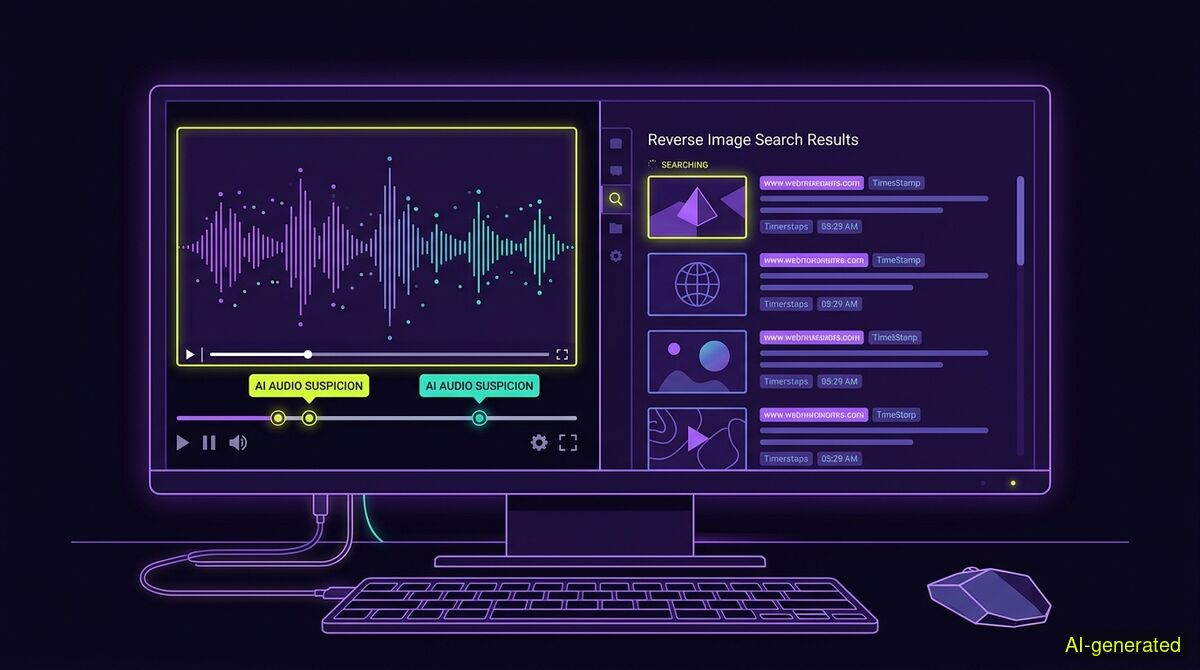
AI-generated illustration. A split computer screen showing a video player with a timeline on one side and a list of reverse image search results on the other.
You can check if a video has fake AI audio by reverse-searching its still frames to find the original footage, which usually reveals the real, unaltered sound. AI voice clones often use real video clips as a base, so finding the source interview exposes the manipulation immediately.
AI-generated false content is growing rapidly across social media platforms. A study funded through the AISI Challenge Fund and reported by Full Fact on October 5, 2026, found that confirmed or suspected AI content now accounts for 24 percent of all their published fact checks. This represents a massive jump from just 8 percent a year earlier.
A highly deceptive format right now is the audio clone. Unlike entirely generated video clips, which often contain visual errors or unnatural physics, an audio deepfake takes a genuine piece of footage and simply changes the words being spoken.
A perfect example surfaced in early October 2026. A viral Facebook video appeared to show Elon Musk warning that billions of people could die by 2030 due to water shortages. As Full Fact verified, this claim was completely false. The video itself was a genuine interview Musk gave to Forbes in May. However, the audio was modified using an artificial intelligence voice clone and a lip-syncing tool. In the real interview, he made no mention of water shortages.
Audio manipulation does not always require advanced artificial intelligence. Often, bad actors simply recycle dramatic sound clips and paste them over unrelated footage.
During the attempted hijacking of a Flydubai flight between Dubai and Tel Aviv, a terrifying video circulated online. It showed a plane descending over a built-up area while passengers screamed in the background. As Full Fact discovered, the visual footage actually showed a different flight flying over Dubai. The screaming audio was lifted from a completely separate turbulence video recorded in 2022.
In other cases, networks create entirely fabricated news broadcasts. France 24 reported on October 1, 2026, that a fake BBC report was circulating about the same Flydubai incident. The deepfake video falsely claimed an Indian passenger was behind the hijacking attempt. The BBC never broadcast the segment, and both the footage and audio were doctored.
This recycling tactic is also common in compilation videos. On October 5, 2026, Full Fact checked a compilation video claiming to show US strikes on Iran. The one-minute clip featured eight different segments. Verification revealed it included old footage from Gaza and Lebanon alongside multiple fake videos. Similarly, the Indonesian National Police reported on October 7, 2026, that a viral video blaming an Anak Krakatoa volcano eruption for stranding thousands of fish was fake. Digital verification showed the video combined recycled footage from Canada with secondary clips that had been circulating on Chinese platforms since 2022.
Because audio is so easy to manipulate, you cannot rely on listening for robotic glitches or unnatural pauses. The most reliable verification method is to isolate the visual footage and find its earliest documented publication date. If you find the original interview or raw clip, you will hear the real, unaltered sound.
You can do this manually by taking screenshots of key moments in the video. Upload those still frames to a reverse image search engine and filter the results by date to find the oldest matching upload.
For an automated approach, wyper includes an AI Spotter feature that generates a provenance report. This feature is not in the free tier for images or video because a provenance report calls three paid services on every single run. It costs 4 credits per video on paid plans. The AI Spotter takes still frames from the clip and searches each one separately. A hit on any frame is a hit on the entire video. Finding the earliest appearance and measuring the date gap between the event and the post catches the most common real video deception, which is old footage relabelled as new. A pixel detector cannot see that context at all.
The report also checks for content credentials like C2PA, verifying them against 55 official trust anchors. A merely valid signature is self-signable, so only a trusted signature counts. However, you must understand how platforms handle these credentials. A content credential sits in its own box beside the picture data. Any repackaging drops it completely, even a lossless repackaging that leaves every pixel untouched. Since social platforms repackage every file upon upload, that layer will almost always find nothing on a video taken off a feed. This is the normal case, not a suspicion. The report says so directly, advising you to check the original file instead where the signature might still be intact.
If you cannot locate the original video, your next step is to fact-check the claim itself. Did the person actually say the quote, or did the event happen as described?
You can search news archives manually to verify quotes. However, finding original sources can be difficult. Our own published measurements of 633 real citations re-fetched showed that while 73 percent were verbatim on the page, 19 percent of pages were unreachable for automated readers due to paywalls, PDFs, or access restrictions. Another 6.4 percent were simply not findable.
You can use the free wyper web app to run a text fact-check on the claim. The text fact-check remains free for up to 5 checks a day with no account required. It returns a truth score of 1-10 alongside an evidence chain of real, linked sources. Wyper never filters sources by origin, meaning there is no mainstream bonus and official sources are not artificially preferred. The tool provides the evidence, but the reader decides what is trustworthy. To maintain transparency, wyper operates a public dispute register. It is append-only and hash-chained, meaning entries cannot be silently edited or removed once recorded.
The standard check uses a Dual-AI cross-check powered by Gemini and Grok. Grok searches for itself there, ensuring the two models do not share one single evidence set. In our own testing of 30 claims with frozen sources, Gemini and Grok agreed in 29 out of 29 cases, even on deliberately contested claims. Because two models trained on overlapping text are correlated rather than independent, confirmation by two AIs carries little information.
This is why the Full Spectrum plan offers a different approach for deepening your research. It uses a Triple-AI reading with three models and one evidence set. The third voice does not search. It receives exactly the sources the main model received and reads them independently. A disagreement here is a different reading of the same material, not a different search result. In our tests, a third model of different origin disagreed in 3 of 26 cases, providing a machine-verified quote every time.
Misinformation often hides behind satire, making it harder to verify. A study published in Scientific Reports on October 6, 2026, highlighted how difficult it is to detect humorous vaccine misinformation on social media using traditional machine learning models. Satire relies on context that automated content moderators frequently miss. Wyper never calls its truth score proof of trustworthiness, and it never judges the intent behind a post. Determining whether a claim was meant as a deliberate deception or a sarcastic joke stays entirely with the reader.
When you encounter a suspicious video, you have several ways to check its authenticity.
| Verification method | Manual checks | wyper web app | wyper extension |
|---|---|---|---|
| Access and cost | Always free | Free tier available | Free tier available |
| Setup requirements | None | No install required | Browser installation |
| Privacy and data | Data stays in browser | Sends claim to server | Runs in active tab |
| Text fact-checking | Search engine queries | 5 free checks per day | 5 free checks per day |
| Video claim checking | Read transcripts manually | Relies on public subtitles | Watches video directly |
| AI Spotter (Provenance) | Reverse image search | Paid plans only | Paid plans only |
Who needs which: Manual checks are best for users who want total privacy and prefer to sift through search engine results themselves, as no data leaves the browser. The wyper web app is ideal for checking claims on a mobile device or a work computer where you cannot install software. The wyper extension is built for heavy researchers who want the tool to watch videos directly within their active browser tab, allowing it to reach content that a disconnected web app cannot see.
Audio deepfakes are increasingly common, often pairing real footage with cloned voices or recycled sound. The most reliable way to verify them is to reverse-search the still frames to find the original interview. Once you locate the source video, you can hear exactly what was actually said.
The wyper Fact-Check extension runs these checks on the post itself: truth score, evidence chain, and the date gap that catches recycled footage.
The web app installs to your home screen in one tap. No store, no account.
Already using it? ★★★★★ Rate it on the Chrome Web Store. Reviews decide what others get shown first.
 wyper
wyper