Language barriers are the blind spot of online verification. Learn how to trace and verify non-English claims using AI tools and primary source evidence.
This article was researched and drafted with AI, then checked and released by a person before it went live. The illustration is AI-generated. Every factual claim links to its source, so you can verify it yourself.
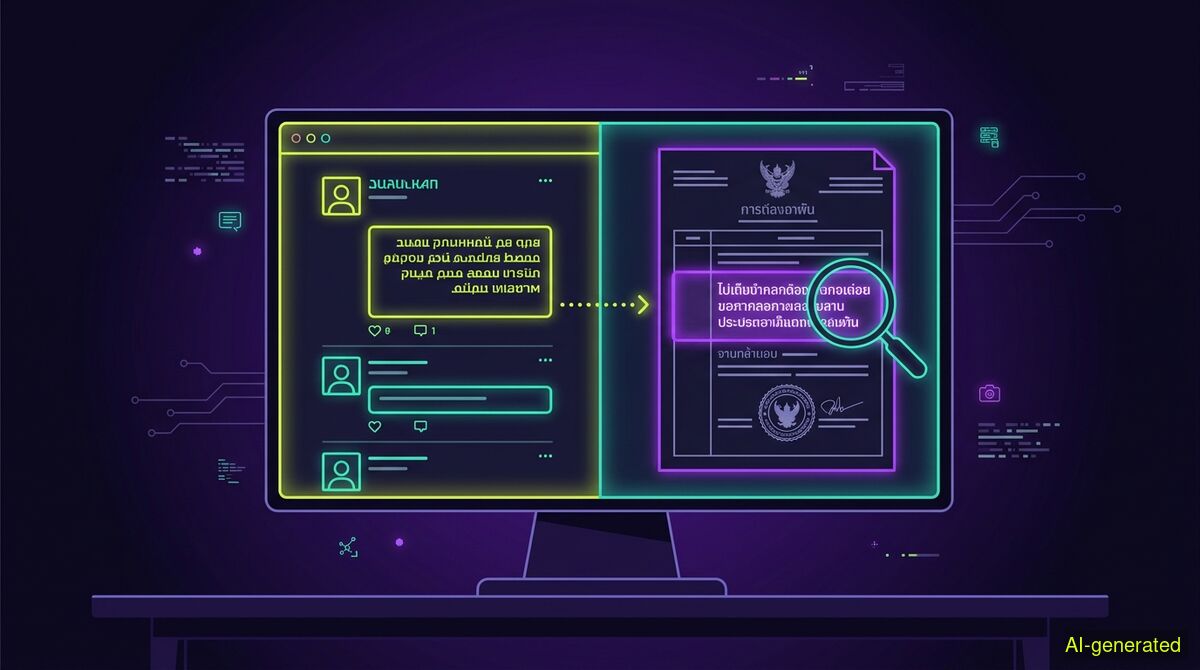
AI-generated illustration. A split monitor screen displaying a social media feed in one alphabet on the left and a highlighted official document in a different alphabet on the right.
To check a claim in a language you do not speak, you must trace the text back to its original cultural and linguistic root rather than relying on translated summaries. Automated tools now use cross-lingual reasoning to fetch non-English primary sources, read them in their native context, and deliver the evidence chain in your own language.
When you set out to fact-check foreign language claim origins, you will quickly notice that the language barrier is the hardest part of the process. The internet operates globally, but our verification habits remain local. A post claiming a specific event happened in another country often circulates in English, yet the primary evidence required to verify it exists entirely in a different language.
Relying on English-language search results to verify a claim from a non-English region creates a severe blind spot. If you only search in your native language, you are entirely dependent on secondary reporting, translated summaries, or international news agencies deciding the story is worth covering. To get to the truth, you have to reach the root source.
For years, the automated analysis of digital claims has focused almost exclusively on English and a few other high-resource languages. This leaves massive gaps in our ability to combat organized manipulation. Manipulative information campaigns specifically target population groups with different cultural backgrounds and often make use of their native languages, as researchers at the FZI Forschungszentrum Informatik noted. The FZI launched the KuKI project to develop systems capable of identifying disinformation across German, Russian, and Turkish, explicitly because existing systems overlook false narratives when they are not in English.
Large language models have shown promise in automating verification, but their effectiveness across global contexts remains highly uneven. A 2026 study published in Scientific Reports evaluated nine established models using 5,000 claims previously assessed by professional fact-checking organizations across 47 languages. The researchers found a concerning pattern resembling the Dunning-Kruger effect: models frequently overestimated their capabilities in multilingual contexts, particularly smaller models.
This inequality is a structural problem in how models are trained and deployed. Research from Hong Kong Baptist University analyzed cross-language inequality in automated fact-checking across nine languages and six language families. They found substantial cross-language disparities, proving that a tool performing well in English might fail entirely when asked to verify a claim originating in Arabic or Hindi.
The intuitive approach for most internet users is to translate a foreign post into English using a browser extension, and then paste that translation into a search engine. This approach routinely fails. Translating a claim strips away local context, regional terminology, and cultural nuances that are essential for a successful search query.
Instead of translating the claim to search in English, effective verification requires cross-lingual reasoning. The system must understand the claim in the user's language, formulate a highly specific search query in the source language, retrieve the local documents, read them in their native context, and finally synthesize the evidence back into the user's language.
Computer scientists are actively building frameworks to solve this. A study in the Journal of Intelligent Information Systems proposed a Multilingual and Multimodal Retrieval-Augmented Generation framework to verify news claims in low-resource settings. Similarly, research published on Zenodo demonstrated a system tailored for Indic languages using a fine-tuned transformer model to process English, Hindi, Tamil, and Bengali simultaneously. Another framework, detailed in the AI and Tech in Behavioral and Social Sciences journal, integrates multilingual representations and claim-evidence alignment features to verify facts in environments with limited labeled data.
To test whether cross-lingual reasoning actually works in practice, we measured our own systems. In a test of 24 claims where the root source was named in advance, our engine successfully reached the primary sources 63 percent of the time. Legacy media accounted for 14 percent of the retrieved evidence, and fact-checkers made up just 1 percent.
Most importantly, all six non-English roots in the test set were successfully reached. The system retrieved original documentation from Russian authorities, rulings from the Mexican Supreme Court, and local Thai sources. The tool bypassed the English-language media filter completely and pulled the primary evidence directly from the countries of origin.
Sources are never filtered by origin in our system. There is no mainstream bonus, and official sources are not automatically preferred over local independent reporting. The system retrieves the evidence, presents the chain of linked sources, and the reader decides what to trust.
When you submit a claim, the standard check runs a Dual-AI cross-check using Gemini and Grok. Grok searches for itself during this process, meaning the two models do not share one evidence set. They independently formulate queries, retrieve documents in the required languages, and compare their findings.
For a more rigorous deepening, the Full Spectrum check introduces a Triple-AI reading: three models, one evidence set. The third voice does not search the web. It receives exactly the same foreign language sources the main model received and reads them independently. If there is a disagreement in this phase, it is a different reading of the exact same material, not a different search result.
Because video claims often cross borders faster than text, handling audiovisual material is critical. When reachable, the system uses subtitles to read the video content. When subtitles are not available, an AI model actually watches the video within a specific time window. The free tier covers up to 10 minutes on YouTube, while Pro covers 30 minutes. For X videos, the limit is up to 2 minutes free and 7 minutes Pro, with longer videos refused outright rather than partially checked.
Regardless of the language the original source was written or spoken in, the output is delivered in your preferred language. The system supports 12 product languages, returning a truth score of 1-10 alongside an evidence chain of real, linked sources. We never call the truth score proof of trustworthiness, and the tool does not judge the intent of the original poster. Both of those judgments stay firmly with you, the reader.
If you want to verify a foreign claim yourself, you can use the free wyper web app in a separate tab, or you can run the browser extension directly over the post you are reading.
| Manual checks | wyper web app | wyper extension |
|---|---|---|
| Free to perform | Free tier available | Free tier available |
| Requires no installation | Requires no installation | Requires browser installation |
| User must translate queries | Auto-translates and searches | Auto-translates and searches |
| User copies text between tabs | User pastes text into the app | Reads text directly from active page |
| No data leaves the browser | Data sent for verification | Data sent for verification |
Who needs which: Manual checking is for users who want total control over their search history and prefer not to send data to any external tool. The web app is designed for people who want automated cross-lingual search capabilities without installing anything on their device. The browser extension is for users who frequently encounter foreign language claims in their social media feeds and want to check them instantly without switching tabs.
Fact-checking a claim from another country requires reaching primary sources in their native language, as translating the claim and searching in English often completely misses the evidence. Modern verification tools bridge this gap by using cross-lingual reasoning to formulate local search queries, read foreign documents in context, and deliver the evidence chain in your language. You can automate this process using either a standalone web application or a browser extension to fetch the root sources directly.
The wyper Fact-Check extension runs these checks on the post itself: truth score, evidence chain, and the date gap that catches recycled footage.
The web app installs to your home screen in one tap. No store, no account.
Already using it? ★★★★★ Rate it on the Chrome Web Store. Reviews decide what others get shown first.
 wyper
wyper