Learn how to trace medical advice from viral posts to primary studies, evaluate risks, and use automated tools to verify health information.
This article was researched and drafted with AI, then checked and released by a person before it went live. The illustration is AI-generated. Every factual claim links to its source, so you can verify it yourself.
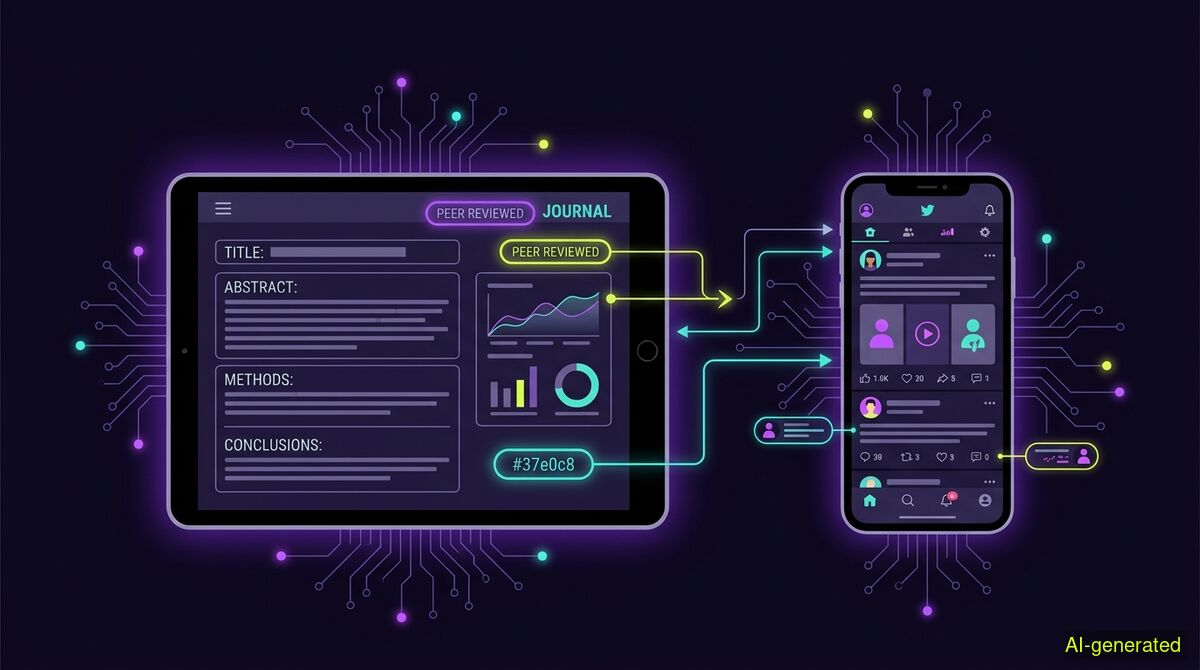
AI-generated illustration. A tablet screen displaying a medical journal abstract next to a smartphone showing a social media timeline.
To fact-check a health claim, you must trace the viral statement back to its primary medical study and verify the sample size and absolute risk. Automated tools can speed up this process by fetching the original research papers and comparing them against the social media post.
Health is the field where bad information causes the highest measurable harm. A fabricated political quote might change a vote, but a misunderstood medical statistic can alter a critical treatment decision. When you need to fact-check a health claim, the stakes demand a rigorous approach that goes beyond simply reading the first few search results.
The digital environment has fundamentally changed how medical data reaches the public. According to a 2026 narrative review in Frontiers in Public Health, digital platforms have transformed access to health information while simultaneously enabling the rapid spread of medical falsehoods. Readers are exposed to a mix of genuine peer-reviewed science, preliminary data, and outright fabrication. Sorting through this requires an understanding of how medical research is structured and how viral posts manipulate that structure.
The most common form of health misinformation is not a complete invention. It is usually a real scientific finding that has been stripped of its context, exaggerated, or applied to the wrong population. To verify a claim, you must trace the social media post back to the primary source.
The first step is identifying the type of publication being cited. In recent years, the line between preprints and peer-reviewed literature has blurred for the general public. A preprint is a manuscript that researchers upload to a public server before it has been evaluated by independent experts. This allows for rapid sharing of data during emergencies, but it also means the methodology has not been formally vetted. Peer review, while not flawless, provides a necessary layer of scrutiny. When a viral post claims a new compound cures a disease, checking whether the linked paper is a preprint or a published journal article is your first line of defence.
Next, you have to look at the sample size and the study subjects. A dramatic headline claiming a certain food destroys cancer cells often leaves out a crucial detail: the experiment was conducted on mice or in a petri dish, not on human patients. Small sample sizes also produce volatile results that rarely hold up in larger clinical trials.
You must also understand the difference between absolute and relative risk. This is the single most exploited metric in health claims. If a condition affects one person in a million, and a new lifestyle habit increases that rate to two in a million, the relative risk has doubled. A social media post will loudly declare a one hundred percent increase in risk. However, the absolute risk remains microscopic. Reading the primary study allows you to see the raw numbers behind the percentages.
During public health crises, the volume of data can overwhelm even careful readers. The way statistics are gathered and reported varies wildly between regions, creating fertile ground for misinterpretation. A 2026 analysis in Frontiers in Medicine mapped the lifecycle of health mis-disinformation from its initial emergence to its amplification in the digital environment. The researchers found that raw epidemiological data is frequently weaponised by removing the methodological caveats.
Consider how case numbers are reported. As documented by World Health Organization epidemiological updates, surveillance data is heavily influenced by testing capacity. A sudden spike in confirmed cases might reflect a true outbreak, or it might simply mean a country rolled out a massive new testing programme. Data collated by Our World in Data in 2025 explicitly notes that due to limited testing, the number of confirmed cases is always lower than the true number of infections. Furthermore, a 2025 comparative analysis in JMIR Public Health and Surveillance highlighted significant inconsistencies in the daily number of reported cases across different data sources.
When a viral post uses a graph to prove a point about disease spread, you have to verify the denominator. Are they showing total cases, or are they showing the share of total tests that were positive? A high raw case count in a densely populated area with widespread testing means something entirely different than a high positivity rate in a region with limited medical infrastructure.
People do not fall for health misinformation simply because they are gullible. Chronic illness and health anxiety drive people to search for answers, sometimes leading them away from established medical consensus. A 2026 structural equation modelling study in BMC Public Health examined adults with chronic diseases in Saudi Arabia. The study found that these patients increasingly depend on online sources for day-to-day self-management. This constant exposure to digital environments leaves them vulnerable to health misinformation of variable credibility.
The consequences of this exposure are measurable. Evidence from Greece published in MDPI demonstrated that susceptibility to online health misinformation directly increases health risk behaviours and vaccine hesitancy. Similarly, a 2026 study in Frontiers in Medicine analysed perceptions of health misinformation on social media among US adults, highlighting how difficult it is for the average user to gauge the amount of false information they encounter. This makes active verification behaviour essential.
Manually tracking down the root of a medical claim takes time, a luxury most people do not have while scrolling through a feed. This is where automated tools bridge the gap. You can use the free wyper web app to evaluate text claims without needing an account or installing anything. You paste the text, and the system fetches the relevant sources.
The standard check runs a Dual-AI cross-check using Gemini and Grok. In this setup, Grok searches for itself, ensuring that the two models do not share a single evidence set. The tool returns a truth score from 1 to 10 along with an evidence chain of real, linked sources. This allows you to immediately see whether a viral health claim is backed by a medical journal or just a blog post.
For deeper analysis, paid tiers offer a Full Spectrum option. This uses a Triple-AI reading: three models, one evidence set. The third voice does not search. Instead, it receives exactly the sources the main model received and reads them independently. This means any disagreement is a different reading of the same material, which is highly useful for complex medical abstracts where interpretation matters.
Our own measurements show why this approach suits health claims. When we tested our source reach, 63 percent of the retrieved links were primary sources, 14 percent were legacy media, and only 1 percent were fact-checkers. This is exactly what you want for a medical claim: the original study, not a secondary opinion. However, the tool has strict boundaries. The truth score measures factual alignment with published evidence, but it is never proof of trustworthiness. Judging the intent behind a post remains entirely with the reader.
| Feature | Manual checks | wyper web app | wyper extension |
|---|---|---|---|
| Cost | Free | Free tier included | Free tier included |
| Setup required | None | None | Browser installation |
| Privacy | No data leaves browser | Text pasted to web app | Runs in active tab |
| Checks posts in-feed | No | No | Yes |
| Traces primary sources | Yes (takes time) | Yes (automated) | Yes (automated) |
Who needs which: The manual route is best for researchers who want absolute control over their search queries and prefer that no data leaves their local browser. The wyper web app is for users who want to quickly verify a copied quote or article text without installing any software. The wyper extension is built for active social media users who want to check posts, pages, and videos directly where they read them, without breaking their scrolling flow.
Fact-checking health claims requires tracing viral statements back to primary medical studies and understanding the difference between relative and absolute risk. Automated tools can quickly retrieve these original sources and provide a truth score based on factual alignment. Ultimately, evaluating the context and judging the intent behind the information remains the responsibility of the reader.
The wyper Fact-Check extension runs these checks on the post itself: truth score, evidence chain, and the date gap that catches recycled footage.
The web app installs to your home screen in one tap. No store, no account.
Already using it? ★★★★★ Rate it on the Chrome Web Store. Reviews decide what others get shown first.
 wyper
wyper