Discover why pixel detectors fail to identify deepfakes reliably and how you can use context, origin tracing and claim verification to find the truth.
This article was researched and drafted with AI, then checked and released by a person before it went live. The illustration is AI-generated. Every factual claim links to its source, so you can verify it yourself.
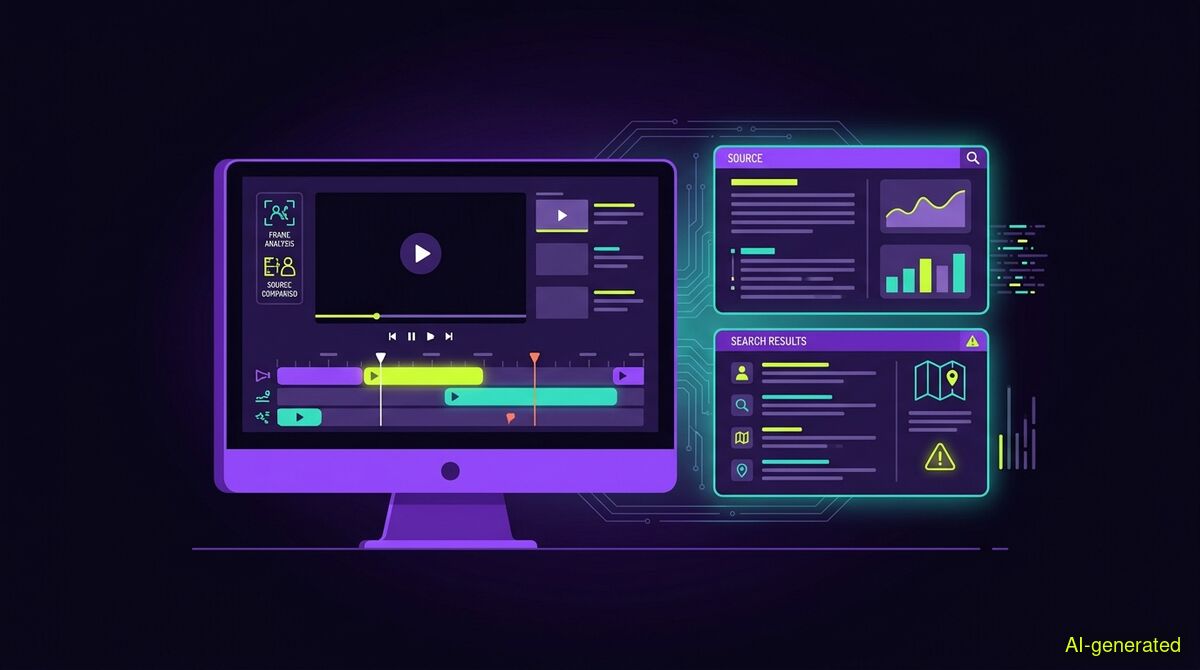
AI-generated illustration. A computer monitor displaying a video timeline next to a split screen showing a source document and a search result list.
To detect a deepfake video reliably, you must verify the context and the claims it makes rather than relying on algorithmic pixel detectors. Software tools that look for visual glitches are easily fooled by modern generation models, making independent source verification the only robust defense.
When you need to detect deepfake video content on your social media feed, your first instinct might be to look for a software tool that scans the pixels and gives you a definitive answer. The internet is full of services claiming they can analyze lighting inconsistencies, unnatural blinking or blurred edges to tell you if a piece of media is synthetic. The reality of artificial intelligence in 2026 is much more complicated. The models generating synthetic video improve so rapidly that forensic pixel analysis is a losing game.
To understand what is real and what is fabricated, you have to stop looking at the pixels and start looking at the context. This means tracing the origin of the video, establishing a clear timeline and checking the factual claims made by the people in the footage.
Deepfake detection software typically relies on finding artifacts. These are microscopic errors left behind by the generation process. For a brief period, this worked well. Early AI videos featured people with six fingers, nonsensical background text and voices that lacked human breathing patterns. Today, those obvious flaws are mostly gone.
As researchers in Scientific Reports explained, most single model deepfake detectors are not very robust because they rely on specific forensic cues and fail to adapt when synthesis methods change. When a new generation model is released, the artifacts change entirely. A detector trained to spot the flaws of a model from 2024 will often miss the output of a model from 2026 completely.
Furthermore, detectors often project a false sense of security. As a 2026 study published on arXiv demonstrated, foundation-model-based detectors frequently exhibit overconfident predictions when faced with manipulations they have not seen before. This overconfidence makes them dangerous for operational deployment. If a tool tells you with 99 percent certainty that a video is real simply because it failed to recognize a brand new generation technique, it actively contributes to the spread of misinformation.
We have seen this exact pattern in our own published measurements at wyper. We measured 240 texts using AI-text detection tools and found them to be highly unreliable. The mathematical reality of generative models is the same across modalities. Whether you are analyzing text, images or video, relying on a classifier to spot synthetic artifacts is a fundamentally flawed approach.
The inability of technical detectors to solve this problem has forced courts and election officials to treat deepfakes as behavioral and contextual problems. The year 2026 has seen a massive surge in synthetic media designed to manipulate political outcomes.
In the United States, Spectrum News 1 reported on a Wisconsin GOP congressman posting deepfake videos of his opponent to make it appear she said things she did not. Meanwhile, CBS Colorado documented a state lawmaker filing a complaint over a deepfake video created by a political think tank. In both cases, the defense against the manipulation was not a pixel detector. It was the public record of what the politicians actually said on those dates.
The international landscape is identical. Valor International reported that opposition parties in Brazil challenged a synthetic video of former President Jair Bolsonaro at the Supreme Court. In South Korea, the Chosun Ilbo reported that police sought arrest warrants for individuals accused of producing AI videos to defame an opponent during local elections. In India, TechTimes reported that a court forced Meta and Google to reveal the identities of anonymous users who uploaded deepfakes falsely linking a cabinet minister to corruption.
These cases share a common thread. The videos were debunked not by algorithmically scanning the video files for pixel glitches, but by tracing the claims back to their source and proving the events never happened.
If pixel forensics are unreliable, you have to verify videos the same way professional researchers verify documents. You test the claims.
First, check the timeline. A deepfake often places a public figure in a specific location at a specific time. You can cross-reference this against their known public schedule, flight records or live appearances. If a video claims a CEO made a controversial statement in New York on a Tuesday, but financial records and live conference footage place them in London that entire week, the video is fabricated.
Second, trace the origin. Who uploaded the video first? If a highly damaging video of a public official surfaces, it should theoretically come from a reputable news organization or an identifiable witness. If the only source is an anonymous social media account created three days ago, your skepticism should be extremely high.
Third, verify the claims made within the audio. This is the most reliable method. If a synthetic voice makes a statistical claim, you can check that statistic against primary sources. If the underlying facts are completely invented, the authenticity of the video file itself becomes irrelevant.
At wyper, we build tools that focus entirely on context and evidence rather than pixel forensics. We do not run deepfake pixel forensics, and we never judge the intent behind a video. Both the judgment and the final conclusion stay with the reader. We provide a truth score of 1-10 alongside an evidence chain of real, linked sources.
When you use our tools to check a video, we rely on the claims made in the footage. If subtitles are reachable, the system uses them. When subtitles are not available, an AI model actually watches the video within a specific time window. For YouTube, the free tier allows checking up to 10 minutes of video, while the Pro tier covers up to 30 minutes. For videos on X, the limits are 2 minutes on the free tier and 7 minutes on Pro. Videos longer than these limits are refused outright rather than being partially checked.
You can paste a URL directly into the free wyper web app to check a video without installing anything. However, the web app cannot see your logged-in YouTube session, which means subtitles are often unavailable there. The wyper Chrome extension runs directly in your browser and can reach more data on YouTube. For videos on X, both tools take the exact same route, so the extension offers no distinct advantage there.
Our architecture relies on separating the models to ensure independence. The standard check uses a Dual-AI cross-check powered by Gemini and Grok. Grok searches the web for itself during this process, ensuring the two models do not share a single evidence set.
We also offer a deeper analysis level called Full Spectrum. The Full Spectrum option utilizes a Triple-AI reading: three models, one evidence set. The third voice in this deepened analysis does not perform its own search. It receives exactly the sources the main model received and reads them independently. A disagreement at this stage represents a different reading of the exact same material, never a different search result.
We publish our own measurements to maintain transparency. In our quote checking tests, involving 633 real citations re-fetched, we found that 73 percent were verbatim on the page. We also found that 19 percent of pages were unreachable for automated readers due to paywalls or PDF formats, and 6.4 percent were simply not findable. Furthermore, all fact-checks are recorded in a public dispute register. This register is append-only and hash-chained, meaning entries cannot be silently edited or removed by anyone.
| Manual checks | wyper web app | wyper extension | |
|---|---|---|---|
| Free to use | Yes (100%) | Yes (Free tier available) | Yes (Free tier available) |
| Installation required | None | None | Chrome extension required |
| Video processing | Manual viewing | AI watches or reads subtitles | AI watches or reads subtitles |
| YouTube subtitle reach | Depends on user | Limited (cannot see session) | High (uses active browser session) |
| X (Twitter) video reach | Manual viewing | Up to 2 min free / 7 min Pro | Up to 2 min free / 7 min Pro |
| Data privacy | Stays in your browser | URL sent to server | URL sent to server |
| Baseline model setup | Human judgment | Dual-AI cross-check | Dual-AI cross-check |
Who needs which: The manual check is best for users who have the time to track down primary sources and prefer that no data leaves their browser. The wyper web app is ideal for users on mobile devices or public computers who need a fast truth score and evidence chain for a specific claim without installing any software. The wyper extension is designed for frequent researchers who want seamless verification directly on the pages and videos they are actively viewing, utilizing their existing browser session to reach subtitles that a remote server cannot see.
Detecting deepfake videos requires ignoring pixel artifacts and focusing instead on verifying the timeline, the origin and the factual claims made in the footage. Tools that rely on visual glitches fail consistently against modern generation models. By using tools that fetch primary sources to verify the actual statements, you can bypass the technical arms race and find the truth reliably.
The wyper Fact-Check extension runs these checks on the post itself: truth score, evidence chain, and the date gap that catches recycled footage.
The web app installs to your home screen in one tap. No store, no account.
Already using it? ★★★★★ Rate it on the Chrome Web Store. Reviews decide what others get shown first.
 wyper
wyper