Learn the three-step process to trace viral quotes back to their primary sources, check their original context and spot fake attributions online.
This article was researched and drafted with AI, then checked and released by a person before it went live. The illustration is AI-generated. Every factual claim links to its source, so you can verify it yourself.
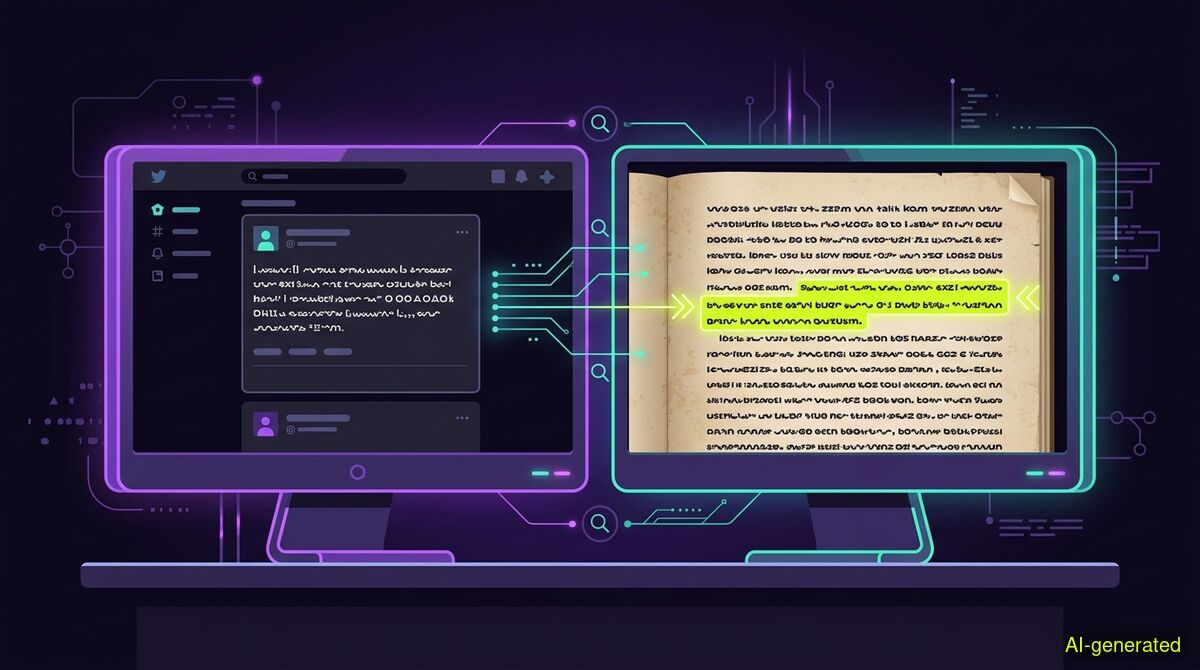
AI-generated illustration. A split computer monitor showing a social media post with text on the left and a scanned page of an old reference book highlighting a single sentence on the right.
To verify a quote, you must isolate a unique phrase from the text, search for that specific string in published works, and read the surrounding context. A quote is only verified when you can point to the exact document, date and page where it first appeared.
When you need to verify a quote you see in a social media image, the text alone is never enough proof. A picture of a famous person placed next to a provocative statement looks highly convincing, which makes it one of the most common formats for online misinformation. The format bypasses traditional text filters, requires no video editing skills and relies on the reader scrolling past before asking for a source.
The internet is flooded with fabricated statements attributed to historical figures and modern celebrities. As Ketan Joshi reported in Crikey, a completely fabricated quote claiming Jeff Bezos said human water consumption was limiting artificial intelligence spread rapidly across social media in June 2026. The text was likely generated by an AI hallucination, yet it was shared widely because it sounded like something a tech billionaire might say. To find out if a quote is real, you need a reliable method to move from a viral screenshot to a primary source. This process requires three distinct steps.
The biggest mistake readers make when trying to verify a quote is typing the entire paragraph into a search engine. If the creator of the meme altered a single word, or if the original translation differs slightly, a full-text search will return zero results.
Duke University provides a literature research guide that advises against searching for an entire quote at once. Their librarians recommend searching using a specific word or a short phrase from the text. If the quote is slightly incorrect, using a small, unique cluster of words will get you much closer to the actual quotation than a rigid search for a long sentence.
Look at the screenshot and pick three or four consecutive words that are highly specific. Ignore common verbs and filler words. Put those specific words in quotation marks in your search engine to force an exact match. If the quote is real, this specific string of words will usually lead you to a book preview, a transcript or an academic paper.
Once you have search results, your goal is to find the earliest documented appearance of those exact words. A quote without a date, a publication or a specific event is highly suspicious. Famous authors and politicians are frequent targets for misattribution because their names lend instant authority to whatever text is placed beside them.
In March 2026, Snopes documented a fake quote attributed to Mark Twain claiming God created war so Americans would learn geography. The claim spread across Reddit, Facebook, Threads and X. However, no historical document ever recorded Twain saying or writing those words. Similarly, the Aleksandr Solzhenitsyn Center had to publicly debunk a lengthy, fabricated quote about the October Revolution that was circulating online under the Russian author's name.
Sometimes, the words are real but the speaker is wrong. For example, a viral image in June 2026 claimed actor Matthew McConaughey praised Donald Trump's bravery. Snopes found that the exact same text had previously been attributed to musician Mick Jagger. The quote was completely fabricated, but the creators simply swapped the celebrity photo to keep the meme circulating.
If you find a quote mentioned in a news article or a blog, that is a secondary source. The Salem State University research guide notes that you must track down the original text. If a blog says a politician made a statement, you must find the transcript of the speech or the video recording of the event to prove it happened.
Finding the exact words in a published book is a victory, but the verification process does not end there. You must read the surrounding paragraphs to understand what the author actually meant.
The Global Fact Checking network warns that a quote can be completely consistent with the original text letter for letter, but still have its meaning entirely distorted. This happens when a quote is arbitrarily cut off or deliberately taken out of context. An honest quote reflects the original meaning, while a manipulated quote uses real words to tell a lie.
A clear example of this involves Planned Parenthood founder Margaret Sanger. A viral claim stated she called Black people human weeds. Snopes confirmed that Sanger did use the exact term human weeds in her eugenics writings. However, she used the term to describe non-specific groups of people based on health and genetics, not race. The words were historically accurate, but the target of the quote was altered by the meme creator to push a different narrative. The reader must always judge the context for themselves.
Tracing quotes manually takes time, especially when the text is buried in long speeches. You can speed up this process using the free wyper web app or the browser extension. Our Fact-Check tool takes the text you want to verify and returns a truth score from 1 to 10, alongside an evidence chain of real, linked sources. Sources are never filtered by origin, meaning there is no automatic preference for mainstream media. The tool simply finds where the text lives and lets you read it.
In our own published measurements of 633 real citations re-fetched by the tool, 73 percent were found verbatim on the page. Another 19 percent of pages were unreachable for automated readers due to paywalls or PDF formats, and 6.4 percent were not findable.
The standard check uses a Dual-AI cross-check powered by Gemini and Grok. Because Grok searches for itself there, the two models do not share a single evidence set. This cross-checking helps identify if a quote has multiple conflicting attributions online.
For deeper investigations, the Full Spectrum option provides a Triple-AI reading: three models, one evidence set. The third voice does not search. It receives exactly the sources the main model received and reads them independently. Any disagreement here is a different reading of the same material, not a different search result. We designed it this way because two models trained on overlapping internet text are correlated, not independent. Having a third model of different origin read the same document is the strongest method we have to verify exact phrasing.
| Manual checks | wyper web app | wyper extension |
|---|---|---|
| Free to use | Free tier available | Free tier available |
| No installation required | No installation required | Requires browser installation |
| No data leaves your machine | Text is sent to our servers | Text is sent to our servers |
| Can read offline physical books | Cannot read offline materials | Cannot read offline materials |
| Reader builds the evidence chain | Returns a linked evidence chain | Returns a linked evidence chain |
| Takes minutes or hours | Takes seconds | Takes seconds |
Who needs which: Casual readers who want to quickly check a suspicious screenshot without installing anything are best served by the wyper web app. Researchers and journalists who spend hours daily verifying claims across social media feeds will benefit from the wyper extension, as it checks posts directly where they appear in the active tab. Readers who need to verify historical quotes from printed archives or paywalled academic journals must rely on manual checks, because automated models cannot reach offline or heavily gated materials.
Verifying a quote requires isolating a unique phrase, searching for it in published works and reading the surrounding context. Tools can automate the search and provide an evidence chain, but they cannot read offline materials or judge human intent. You must always review the primary source yourself to ensure the meaning was not distorted.
The wyper Fact-Check extension runs these checks on the post itself: truth score, evidence chain, and the date gap that catches recycled footage.
The web app installs to your home screen in one tap. No store, no account.
Already using it? ★★★★★ Rate it on the Chrome Web Store. Reviews decide what others get shown first.
 wyper
wyper