Blind trust is a vulnerability. A reliable fact-checking tool provides raw data, verifiable evidence chains, and a public error rate you can check yourself.
This article was researched and drafted with AI, then checked and released by a person before it went live. The illustration is AI-generated. Every factual claim links to its source, so you can verify it yourself.
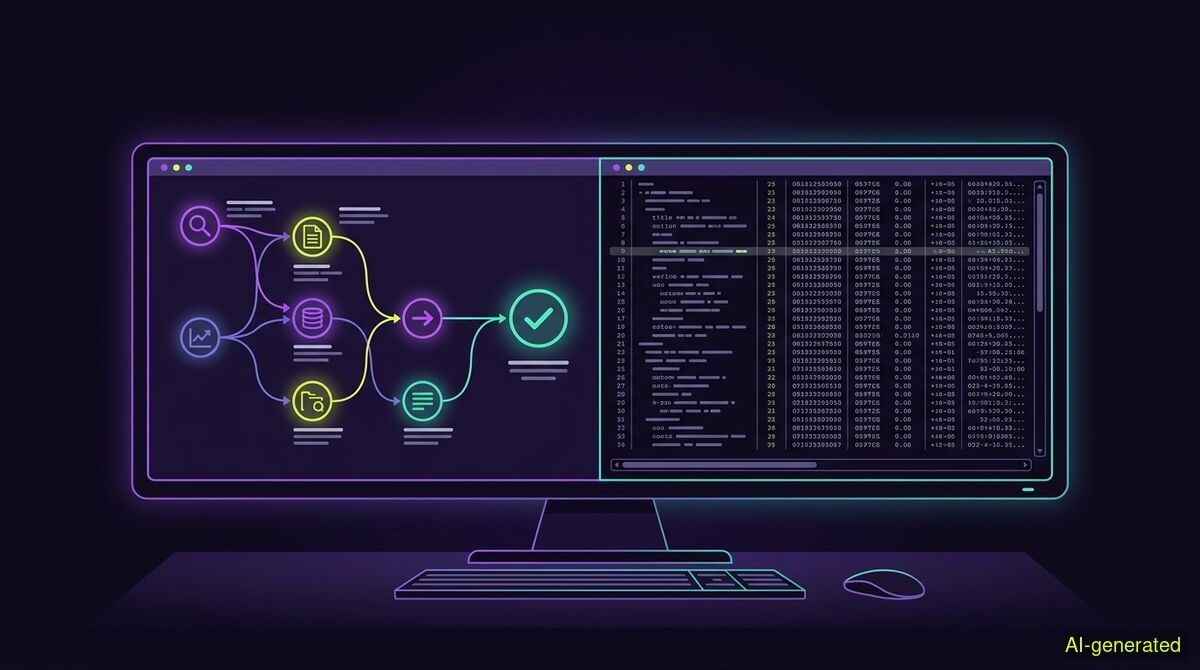
AI-generated illustration. A split computer monitor displaying an evidence chain on the left and a raw data log on the right.
You should never trust a fact-checking tool blindly, but rather demand verifiable evidence chains and published error rates. A system that shows you its raw data, unreachable sources, and disagreements between AI models allows you to verify its conclusions instead of just believing them.
When someone asks why they should trust a fact checking tool, the only responsible answer is that they should not trust it blindly. Trust is a vulnerability. In an information environment defined by synthetic media and automated distribution, demanding blind faith is a failing strategy. Confidence must be earned through verifiable raw data, transparent methods, and a willingness to publish failure rates alongside successes.
Public confidence in news and verification is currently at a record trough. A 2026 transparency audit by PressVerified evaluated seven major newsrooms against their published standards for verification and AI use. The audit highlighted a grim reality drawn from the Reuters Institute 2025 Digital News Report, which placed trust in news in the United Kingdom at just 35 percent. The Edelman 2026 Trust Barometer similarly flagged journalism as the only major institution to register a year-on-year decline across all G7 markets. Against this backdrop, asking readers to simply believe a "True" or "False" label is inadequate.
Historically, fact-checking relied heavily on institutional authority. Peer-reviewed research has examined how major organizations function within this ecosystem. As Factually reported in 2026, data-driven studies assess source transparency, correction practices, and the consistency of verdicts across organizations. These studies show that established players conform to common fact-checking norms.
However, human oversight is fallible. In July 2026, a reader flagged suspicious writing on a major verification site. As Snopes subsequently disclosed, newsroom leaders identified 13 articles by a former staff member that contained undisclosed AI-assisted writing. The investigation eventually scanned 180 articles published under that employee's name. This incident demonstrates that even dedicated verification teams experience structural failures. If the process is not fully transparent, the output cannot be verified by the public.
To address these vulnerabilities, verification must move from institutional authority to structural transparency. The Fact Check Checker protocol, published in early 2026, introduced a structure-first approach to auditing fact-checks. It reconstructs what was meant from primary sources and compares it with what was reported as fact. It detects structural mislabeling such as metaphor-to-fact conversion or condition stripping. Crucially, it does not judge speakers or infer intent. It produces a transparent audit result before any judgment is made.
We believe that trust is not claimed, but made verifiable. We publish our hit rates with raw data because hiding limitations destroys credibility. Our own published measurements serve as citable primary sources for our accuracy and our blind spots.
In our quote checking measurements, we re-fetched 633 real citations. The results showed that 73 percent of quotes were verbatim on the page. More importantly, we openly report that 19 percent of pages were unreachable for automated readers due to 403 errors, PDFs, or paywalls, and 6.4 percent were simply not findable.
Our source reach metrics are equally public. Testing 24 claims with the root named in advance, we reached primary sources 63 percent of the time, legacy media 14 percent of the time, and fact-checkers 1 percent of the time. We also successfully reached all 6 non-English roots in the test set.
Who else shows a 19 percent failure rate for automated readers? We publish our own misinterpretations, correct them, and leave the original errors visible. We maintain a public dispute register that is append-only and hash-chained. Entries cannot be silently edited or removed, ensuring a permanent record of our methodological history. This aligns with modern digital evidence standards. The EviChain Standard specifies requirements for digital evidence management systems to ensure the integrity and defensibility of evidentiary material. Similarly, 2026 research on the Modulign architecture argues that chain-of-custody documentation must be integrated into the evidence itself, rather than appended as an external procedural record.
Our standard check utilizes a Dual-AI cross-check featuring Gemini plus Grok. Grok searches for itself in this configuration, ensuring that the two models do not share a single evidence set. This separation is vital for independent verification.
When a deeper analysis is required, our Full Spectrum option provides a Triple-AI reading: three models, one evidence set. The third voice does not search. It receives exactly the sources the main model received and reads them independently. Therefore, a disagreement is a different reading of the same material, not a different search result.
Our own frozen source tests revealed a critical insight about AI consensus. Across 30 claims, Gemini and Grok agreed in 29 of 29 cases, even on deliberately contested claims. Two models trained on overlapping text are correlated, not independent. Therefore, being "confirmed by 2 AIs" carries very little information. However, a third model of different origin disagreed in 3 of 26 cases, every time with a machine-verified quote. This is the strongest evidence we have for our methodology, and it argues directly against a claim we used to make ourselves.
The standard fact-check returns a truth score of 1-10 plus an evidence chain of real, linked sources. This truth score is never a proof of trustworthiness, and the tool never judges the intent of the author. Both of those judgments stay firmly with you, the reader. Sources are never filtered by origin. There is no mainstream bonus and no preference for official sources.
Video verification requires a specific set of rules. The tool uses subtitles when they are reachable. When subtitles are not available, an AI model actually watches the video within a specific time window. Free tier users get up to 10 minutes for YouTube videos, while Pro users get 30 minutes. For videos on X, the limit is 2 minutes on the free tier and 7 minutes on Pro. Longer videos are refused outright rather than being partially checked. The system does not run deepfake pixel forensics.
For advanced provenance tracking, we offer the AI Spotter. This is available only in the web app and is not included in the free tier. It costs 1 credit per image and 4 credits per video, requiring a paid plan. A provenance report calls three paid services on every single run, making a free tier impossible for this specific feature. However, the text fact-check remains completely free, allowing 5 checks a day with no account required.
The AI Spotter is a provenance report, never a detector. It never outputs a percentage of how artificial something looks, because that arbitrary number is the exact harm we exist to prevent. It verifies content credentials against 55 official trust anchors. Only a trusted signature counts, as a merely valid one is self-signable. This standard reflects the strict requirements detailed in the Proof Protocol Provenance Specification, which defines verifiable evidence of origin and custody chain.
For video, the AI Spotter takes still frames and searches each one separately. A hit on any frame is a hit on the video. It is crucial to understand how platforms handle these files. A content credential sits in its own box beside the picture data. Any repackaging drops it, including a lossless repackaging that leaves every pixel untouched. Social media platforms repackage files on upload. Therefore, on a video taken off a feed, the credential layer will almost always find nothing. That is the normal case, not a suspicion, and the report states this clearly. What carries the actual weight for video verification is the earliest documented appearance plus the event-versus-post date gap. This catches the most common real video deception: old footage relabelled as new.
If you want to verify claims without installing anything, you can use the free wyper web app directly in your browser. The web app cannot see your YouTube session, meaning subtitles are often unavailable there, but it performs the same rigorous text checks. For checks directly on your social media feeds, the browser extension integrates into your active tabs.
| Feature | Manual checks | wyper web app | wyper extension |
|---|---|---|---|
| Cost | Free | Free tier available | Free tier available |
| Fact-checking output | None | 1-10 score plus evidence chain | 1-10 score plus evidence chain |
| Video watching | Manual viewing only | AI watches (up to 10 min free) | AI watches (up to 10 min free) |
| Browser session access | None | None | Uses your active logged-in tab |
| YouTube subtitles | Manual reading | Often unavailable (no session) | Reaches more via your session |
| Installation required | None | None | Browser extension required |
Who needs which: Casual readers who want to occasionally verify a news article or a copied block of text should use the web app, as it requires no installation and leaves no trace on your machine. Researchers and frequent social media users who want to verify claims, videos, and posts directly on X or YouTube without switching tabs should install the extension. Those who require deep provenance reports for specific images or videos must use the paid AI Spotter feature within the web app.
Blind trust is a vulnerability in modern information spaces. A reliable verification tool provides a transparent evidence chain, publishes its failure rates, and leaves the final judgment of intent to the reader. By exposing the raw data and the disagreements between models, you gain the ability to verify the check itself.
The wyper Fact-Check extension runs these checks on the post itself: truth score, evidence chain, and the date gap that catches recycled footage.
The web app installs to your home screen in one tap. No store, no account.
Already using it? ★★★★★ Rate it on the Chrome Web Store. Reviews decide what others get shown first.
 wyper
wyper