Learn how to fact-check viral claims about bot networks, using recent rumors about Russian data centers as a practical guide for finding primary evidence.
This article was researched and drafted with AI, then checked and released by a person before it went live. The illustration is AI-generated. Every factual claim links to its source, so you can verify it yourself.
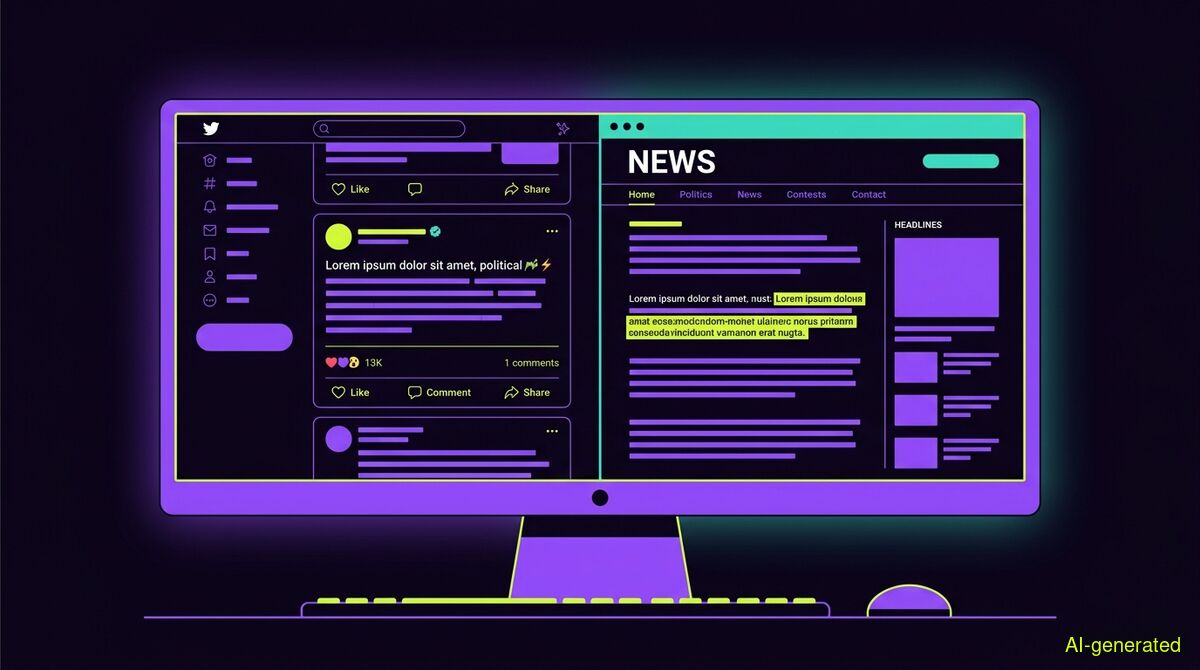
AI-generated illustration. A split computer monitor displaying a social media feed with a viral political post on the left and a highlighted news article refuting the claim on the right.
You can verify claims about bot networks by separating the confirmed physical event from the unproven digital impact and checking for consensus among independent tracking organizations. Viral political rumors often link two unrelated events to create a satisfying narrative, making it essential to trace the evidence back to primary sources before sharing the claim.
Viral narratives move fastest when they confirm what people already suspect. When a story provides a neat, satisfying explanation for a complex problem, social media users often share it without waiting for proof. We see this pattern constantly during elections and geopolitical conflicts, where physical events are hastily linked to digital phenomena.
A perfect example surfaced in mid-October 2026. Following reported drone strikes on Russian technology company Yandex, a widespread rumor claimed that these attacks had successfully taken down vast networks of Kremlin-linked social media bots. Even Ukrainian President Volodymyr Zelensky amplified the narrative, stating there was less hate and fewer provocations online because there were fewer bots. The claim felt right to many users who wanted to believe that a physical strike could instantly clean up their social media feeds. But feeling right is not the same as being true.
To verify a claim like this, you have to break it down into testable parts and look for primary evidence.
The most effective misinformation usually contains a grain of truth. In the Yandex case, the physical event was real. The technology giant did report that drone strikes damaged its servers in Sasovo, Kaluga, and Vladimir. The deception, or at least the unproven leap, lay in the supposed consequence.
According to research published on October 13, 2026, BBC Verify reported that experts found no evidence the attacks significantly reduced Russian influence operations. These campaigns, which promote pro-Kremlin narratives across social media, have been tracked by researchers for more than a decade. If a massive, sudden drop in bot activity had occurred, the organizations monitoring these networks would have recorded it in their data.
Similarly, Snopes confirmed that claims stating the strikes caused right-wing or MAGA social media activity to decrease remain completely unproven. State-sponsored influence operations are typically distributed across multiple servers, cloud providers, and geographic locations specifically to avoid a single point of failure. A commercial data center going offline does not automatically silence a decentralized bot farm.
We see the same pattern of jumping to conclusions in domestic politics. When a public figure disappears from the spotlight for a few days, the information vacuum is immediately filled with extreme theories. In early October 2026, state Representative James Talarico, a Democratic candidate for the U.S. Senate in Texas, was absent from the campaign trail for nine days. Conservative social media accounts quickly spread rumors that he had suffered a mental health crisis and was institutionalized in Ohio.
The reality was entirely mundane. As FactCheck.org reported, a mental health center in Ohio completely rebutted the false rumors, and the candidate was simply at home in Texas recovering from the flu. KWTX also noted that Talarico was seen at the Austin City Limits music festival shortly after his absence. In both the Yandex and Talarico cases, the verification process requires ignoring the viral speculation and checking the dull, verifiable facts.
When you encounter a bold claim about digital networks or political figures, your first step is to isolate the core assertion. Ask yourself what piece of data would definitively prove the claim true. For bot networks, that data would be a measurable drop in automated traffic published by independent cyber researchers. For a politician's whereabouts, it would be a statement from a hospital, a campaign office, or photographic evidence of them elsewhere.
Next, you must locate the primary sources. Do not rely on screenshots of news articles, as these are easily fabricated or taken out of context. Search for the names of the people or organizations involved. If a post claims a specific news outlet reported a fact, go directly to that outlet's website and search their recent publications.
This manual process takes time, which is why many people skip it. You can speed up the research phase by using the free wyper web app in your browser. You paste the text or link of the claim, and the tool returns a truth score from 1 to 10 alongside an evidence chain of real, linked sources. It is important to note that you should never call the truth score proof of trustworthiness, and never say the tool judges intent. Both of those responsibilities stay entirely with the reader. The tool simply fetches the context so you can make an informed decision.
When you run a standard check, the system uses a Dual-AI cross-check consisting of Gemini and Grok. Grok searches the internet for itself during this process, meaning the two models do not share one identical evidence set. They process the available data and present a consolidated summary of what the primary sources say.
However, automated readers have strict limits. Our own published measurements show the reality of relying on machines to read the internet. In a test of quote checking across 633 real citations that were re-fetched by the system, 73 percent were found verbatim on the page. But 19 percent of the pages were completely unreachable for automated readers because they were blocked by 403 errors, trapped in PDFs, or hidden behind paywalls. Another 6.4 percent were simply not findable.
This is exactly why sources are never filtered by origin in our system. There is no mainstream bonus and no preference for official sources. The system retrieves what is publicly accessible and reachable, and the reader decides what carries weight. Furthermore, all disputes regarding the system's output are recorded in a public dispute register. This register is append-only and hash-chained, meaning entries cannot be silently edited or removed by anyone.
In the fact-checking space, it is common to assume that if two different AI models agree on a verdict, the conclusion must be solid. Our own measurements proved this assumption wrong.
When we tested two models agreeing across 30 claims with frozen sources, Gemini and Grok agreed in 29 out of 29 cases, even on deliberately contested claims. Because two models trained on overlapping internet text are correlated rather than independent, their agreement carries very little new information. Saying a fact is confirmed by two AIs is a weak signal.
To solve this, the wyper extension offers a Full Spectrum deepening option. This runs a Triple-AI reading: three models, one evidence set. The third voice in this process does not search the internet at all. It receives exactly the sources the main model received and reads them independently. If a disagreement occurs, it is a different reading of the exact same material, not a different search result. In our tests, a third model of different origin disagreed in 3 of 26 cases, and every single time it did so with a machine-verified quote. This is the strongest verification method we have, and it actively argues against the claim that two popular models are enough.
| Feature | Manual checks | wyper web app | wyper extension |
|---|---|---|---|
| Cost | Free | Free tier available | Free tier available |
| Installation | None required | None, runs in browser | Chrome extension required |
| Fact-checking method | User searches and reads | Dual-AI cross-check | Dual-AI cross-check |
| Deepening option | Manual reading | None | Full Spectrum option |
| Privacy and data | Stays entirely in browser | Queries sent to servers | Queries sent to servers |
Who needs which: The manual route is best for users who want maximum privacy, as no search queries leave their browser session, though it requires the most time and effort to read through primary sources. The wyper web app is built for users who want to quickly verify a text claim or a link without installing any software or creating an account. The wyper extension is designed for researchers and heavy social media users who want to check posts directly in their feed and require the Full Spectrum reading option to analyze complex or contested political claims.
Verifying claims about bot networks requires separating real physical events from unproven digital consequences. You can track down primary sources manually or use tools to cross-check the evidence, keeping in mind that automated readers cannot access paywalled or blocked sites. The final judgment on any claim always rests with you, the reader, based on the primary evidence provided.
The wyper Fact-Check extension runs these checks on the post itself: truth score, evidence chain, and the date gap that catches recycled footage.
The web app installs to your home screen in one tap. No store, no account.
Already using it? ★★★★★ Rate it on the Chrome Web Store. Reviews decide what others get shown first.
 wyper
wyper