Learn how to trace viral screenshots of leaked documents back to their primary sources and verify distorted medical statistics using real evidence.
This article was researched and drafted with AI, then checked and released by a person before it went live. The illustration is AI-generated. Every factual claim links to its source, so you can verify it yourself.
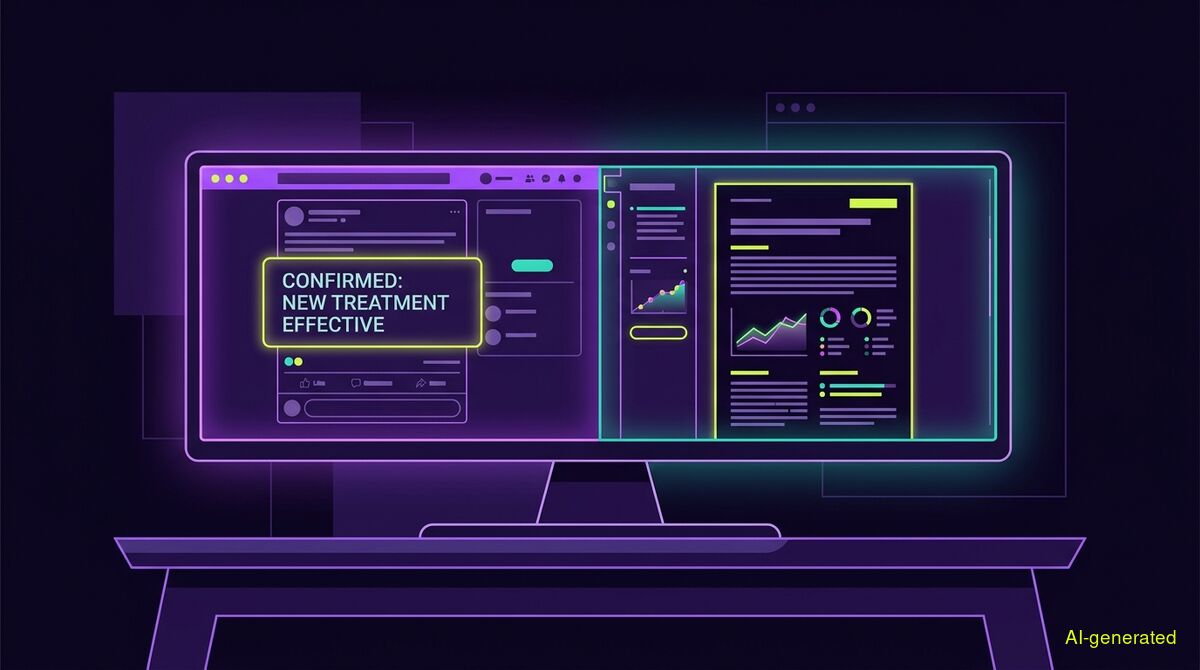
AI-generated illustration. A split computer monitor displaying a social media post with a highlighted text message on one side, and a formal medical research paper on the other.
To verify leaked texts and medical statistics, you must locate the original document release and the primary study rather than trusting social media summaries. Viral claims often isolate a single sentence or data point, stripping away the methodology and preceding conversation that give the information its actual meaning.
In mid-August 2026, a highly specific narrative swept across social media platforms, combining government communications with alarming medical statistics. On August 10, lawmakers released text messages from Dr. Anthony Fauci's government-issued cell phone dating back to January 2021. The following day, as FactCheck.org reported, Senator Rand Paul posted on X claiming that Fauci privately admitted concerns about vaccine side effects associated with first-trimester miscarriages while publicly dismissing any worries. Almost immediately, viral posts amplified this claim, asserting that the texts proved Fauci actively covered up data showing an 82 percent miscarriage rate among pregnant women who received the mRNA vaccine in their first trimester.
However, as Snopes noted, this narrative is entirely false. It relies on a gross misrepresentation of both the January 2021 text messages and the data from a separate 2021 medical study. This incident provides a perfect case study in how misinformation combines out-of-context government communications with distorted medical statistics to create a convincing, yet fabricated, scandal. When you encounter a post claiming a leaked document proves a shocking statistic, you have to separate the two elements and verify them independently.
The first step in manual verification is securing the primary source of the leaked communication. When screenshots of text messages or emails circulate online, they are almost always curated to provoke a specific emotional response. Social media posts frequently crop out timestamps, preceding messages, and the identities of other people in the conversation. In this case, reading the full August 10 release provides the necessary context. The texts show a routine discussion about monitoring incoming safety data and evaluating early reports, not an admission of a covered-up 82 percent miscarriage rate. You must read the primary source document rather than relying on a partisan summary or a heavily cropped screenshot. To do this, search for the exact phrases used in the screenshots alongside the names of the individuals involved and the current year. News outlets, congressional committees, and government websites often publish the full document releases, allowing you to read the context that social media screenshots intentionally obscure.
The second half of the claim relies on a specific mathematical figure: an 82 percent miscarriage rate. When verifying medical statistics, you cannot just look at a screenshot of a data table or a confident social media post. You have to locate the original study and read its methodology and conclusion. The 82 percent figure does not come from a hidden government database; instead, social media users misrepresented data from a publicly available 2021 study. Those spreading the claim calculated the percentage by looking only at a specific, narrow subset of participants while ignoring the broader data set and the study's actual conclusion.
Studies have consistently shown no connection between COVID-19 vaccination during pregnancy and an increased risk of miscarriage. If a social media post claims a study found a catastrophic side effect, but the study's authors explicitly state their findings show no such thing, the post is manipulating the data. Evaluating these claims requires patience. You must locate the study in a medical journal, read the abstract, examine the limitations section, and compare the authors' own conclusions against the viral claim.
Often, these complex claims are not just shared as text posts but are converted into talking-head videos or long-form podcasts to increase engagement. If you are watching a video essay breaking down the "leaked texts," manual verification can feel overwhelming. If you prefer an automated approach to evaluating viral claims, wyper provides two distinct tools. The free wyper web app is a dedicated verification tool; it does fact-checking only and cannot delete, unfollow, or clean up your social media history. When you input a claim, it returns a truth score of 1 to 10 along with an evidence chain of real, linked sources.
If the claim is embedded in a video, the system attempts to use subtitles when reachable. When subtitles are not available, an AI model actually watches the video within a strict time window. For YouTube videos, this window is 10 minutes on the free tier and 30 minutes on the Pro tier. For videos on X, the limit is 2 minutes on the free tier and 7 minutes on the Pro tier. Any video exceeding these limits is refused outright, not partially checked.
It is critical to understand the limitations of this technology. The AI does not run deepfake pixel forensics to detect visual manipulation, and it does not judge the intent of the creator. It strictly evaluates the spoken or written claims against available evidence. Furthermore, the sources provided in the evidence chain are never filtered by origin. The system applies no mainstream bonus, and official sources are not inherently preferred. The tool presents the evidence, and the reader decides what to trust.
Because the web app cannot see your logged-in YouTube session, subtitles are often unavailable there. The wyper Fact-Check extension, which also has a free tier, runs directly in your browser and can reach more subtitle data on YouTube. However, for videos on X, both the web app and the extension take the exact same route, meaning the extension offers no distinct advantage on that specific platform.
| Manual checks | wyper web app | wyper extension | |
|---|---|---|---|
| Cost & Access | Free, no installation required | Free tier available, no installation required | Free tier available, requires browser installation |
| Output | Your own notes and bookmarks | Truth score of 1-10 with an evidence chain of linked sources | Truth score of 1-10 with an evidence chain of linked sources |
| Video Limits | You watch the entire video yourself | AI watches 10 min (YouTube) or 2 min (X) on free tier | AI watches 10 min (YouTube) or 2 min (X) on free tier |
| YouTube Access | Full access via your own browser | Struggles to reach subtitles without a logged-in session | Can reach more subtitles via your browser session |
| Privacy | No data leaves your browser | Video URLs and text claims are sent to the server | Video URLs and text claims are sent to the server |
| Source Filtering | You decide which sources to trust | Reader decides; no mainstream bonus applied | Reader decides; no mainstream bonus applied |
Who needs which: Casual readers who want to occasionally check a viral news link or a suspicious statistic without installing anything should use the web app. Dedicated researchers, journalists, and heavy YouTube users who need to check claims continuously as they browse their feeds will benefit from the extension, as it can access subtitles that the web app cannot reach. Users who prefer to keep all their browsing data entirely local and rely on their own investigative skills should stick to manual checks.
Verifying leaked texts and medical claims requires tracing screenshots back to their primary documents and full data sets. Whether you read the original studies manually or use tools to evaluate the claims, context is the only defense against manipulated statistics.
The wyper Fact-Check extension runs these checks on the post itself: truth score, evidence chain, and the date gap that catches recycled footage.
The web app installs to your home screen in one tap. No store, no account.
Already using it? ★★★★★ Rate it on the Chrome Web Store. Reviews decide what others get shown first.
 wyper
wyper