Admissions officers review social media profiles. Learn how the US application timeline works and how to clean up your digital footprint before November.
This article was researched and drafted with AI, then checked and released by a person before it went live. The illustration is AI-generated. Every factual claim links to its source, so you can verify it yourself.
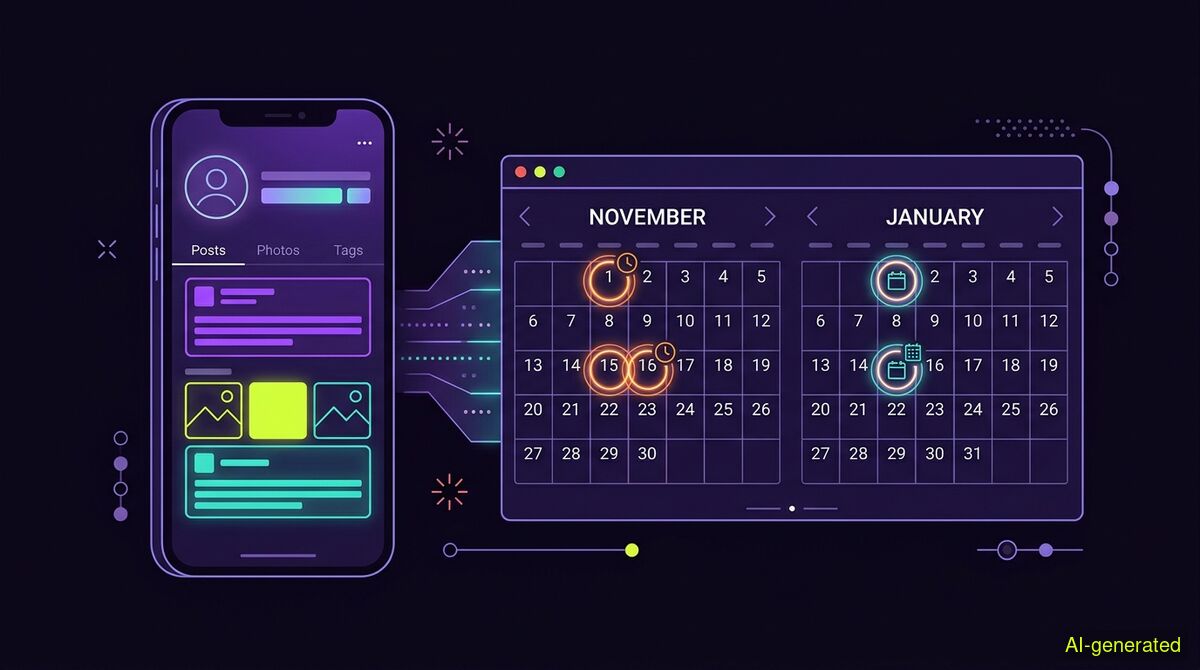
AI-generated illustration. A smartphone displaying a social media profile next to a calendar highlighting November and January dates.
College admissions officers do check applicants' social media profiles, with a 2023 survey showing that 28 percent look at these accounts and 67 percent consider them fair game. Cleaning up your digital footprint before the November to January application deadlines ensures your public presence reflects your current character and maturity.
High school seniors face a demanding window between November and January. Transcripts are sent, essays are drafted, and recommendation letters are finalized. But beyond the official paperwork, there is another layer of scrutiny that applicants often overlook until the last minute. A college admissions social media check is now a standard part of the application process for many competitive institutions.
Universities want to build campus communities filled with mature, responsible students. While your grades show your academic potential, your online presence offers an unfiltered look at your character. Understanding how admissions officers view your digital footprint gives you a distinct advantage as you prepare your applications.
Admissions officers are open about their use of digital platforms to evaluate prospective students. According to a 2023 Kaplan survey, 28 percent of admissions officers viewed applicants' social media content on platforms like Instagram, X, TikTok, and YouTube to learn more about them.
The survey also revealed a growing consensus among university staff regarding the ethics of online screening. A near record 67 percent of admissions officers stated that they consider viewing social media accounts "fair game" in the process of deciding which candidates to admit. They view public profiles as extensions of your application.
This scrutiny is not inherently negative. Admissions teams are not solely looking for reasons to reject applicants. They often check platforms to verify extracurricular activities, view art portfolios, or get a fuller picture of how you spend your time. The Beacon reported on older survey data indicating that when officers checked social media, 38 percent found material that had a positive impact on the applicant's chances. However, 32 percent found content that had a negative impact. The goal is to ensure your public accounts fall into the first category.
Students often believe that restricting their profiles to private settings or participating only in closed groups protects them from university oversight. History shows this is a dangerous assumption.
The most prominent example occurred at an elite Ivy League institution. Harvard University rescinded offers of admission to at least ten incoming freshmen after discovering offensive memes in a private Facebook group. The chat forum was an offshoot of an official online page for admitted students. The incoming freshmen exchanged images mocking sexual assault and tragedy, assuming their closed group was safe from administrative eyes.
Other members of the chat group took screenshots and reported the behavior to the university. Harvard acted swiftly. The university's official policy, detailed in a warning to incoming students, states that the college reserves the right to withdraw an offer of admission if a student engages in behavior that brings their honesty, maturity, or moral character into question. Private posts stop being private the moment someone else decides to take a screenshot.
This digital scrutiny does not end after your undergraduate years. If you are applying to business school, law school, or medical programs, the stakes are arguably higher.
MBA application consultants note that admissions committees assess how your character is reflected in your general online presence, mirroring the background checks conducted by corporate recruiting firms. Graduate programs are fiercely protective of their brand reputations. They expect applicants to exhibit professional judgment. If an MBA admissions officer searches your name and finds a timeline filled with aggressive arguments on X or inappropriate comments on Instagram, your application will likely be denied regardless of your test scores.
To effectively manage your digital footprint, you must align your cleanup efforts with the US college application calendar. Most university application portals open on August 1, but the critical deadlines hit rapidly in the autumn.
Clarity Prep compiled the major deadlines for the admissions season. November 1 is the biggest early date of the year, with 259 colleges closing their early decision or early action windows. Another 177 colleges have their early deadlines on November 15.
If you miss the early windows, the regular decision deadlines arrive quickly. CollegeVine confirms that highly competitive American colleges, including Ivy League schools like Harvard, Princeton, and Columbia, typically set their regular decision deadlines between January 1 and January 15. The University of California system has a slightly earlier regular application deadline of November 30.
Because applications are submitted and reviewed in this tight window, your social media accounts must be clean and presentable well before Halloween.
The first step in any digital audit is to search your own name on major search engines to see what appears on the first two pages of results. Next, log into your social media accounts and view your profiles exactly as the public sees them.
You should specifically check your accounts for hate speech, illegal activities, underage drinking, and excessive profanity. Beyond posts you have authored, you must also review the content you have engaged with. Liking an offensive post on X or leaving a crude comment on a friend's Instagram photo leaves a public trail that admissions officers can easily follow.
For students who only have a few dozen posts, manually scrolling through your timeline and deleting questionable content is the most straightforward approach. However, if you have spent years heavily active on X and Instagram, manually unliking hundreds of posts or deleting old replies becomes a massive logistical challenge.
When manual deletion takes too much time, applicants often turn to automated tools. If you choose to use the wyper Social Cleanup Chrome extension, you can clear specific categories of content on X and Instagram. The extension handles posts, replies, comments, likes, and reposts. It can also manage your network by unfollowing accounts or removing followers.
The most common misunderstanding about our product involves time filters. There is no date filter and no date range in the extension. You cannot instruct the tool to delete tweets older than two years. The honest answer is that keywords are the available filter. You can delete only items containing a specific word, a targeted @name, or a particular #tag. You can enter several keywords separated by commas. There is also an INVERT option that deletes everything that does not contain your chosen keywords, which works specifically on X posts and replies.
The extension operates with a free tier that allows 50 deletions per day. For users who need to clear out years of history, a Pro upgrade removes the daily limit. The Pro version also produces a deletion receipt that lists counts of deleted items without storing the content itself, providing a shareable proof link. Because clearing a massive backlog takes time due to platform rate limits, the extension can show small games in the browser panel while a long run works through your list.
Before starting any cleanup, you must understand that deletion is irreversible. The extension warns you before it starts, but once a post or like is removed, it cannot be restored. There is no export function and no download option for your content within the tool. If you want to save your memories, you must request your data archive directly from X or Instagram before you begin deleting.
There is a fundamental technical difference between this browser extension and cloud-based deletion services. Competing services can delete your posts on a schedule or while you are away from your computer. They can do this because you grant them standing OAuth authorisation to access your account. You effectively hand over the keys to your profile so their servers can act on your behalf.
We take a different approach. The extension requires no password, no API key, and no OAuth authorisation. Its only browser permissions are storage and activeTab, meaning it acts only in the tab you already have open, logged in as yourself. The consequence of this privacy model is a direct trade: because we hold no authorisation, we cannot delete on a schedule or while you are away. No open tab means no run. They can do it because you gave them the keys, and we cannot because we never ask for them.
| Feature | Manual cleanup | wyper Social Cleanup extension |
|---|---|---|
| Platforms supported | All platforms | X and Instagram only |
| Cost | Free | Free tier (50/day), Pro for unlimited |
| Installation required | None | Chrome extension required |
| Account access | None | None (uses your active logged-in tab) |
| Filtering options | Visual scanning | Keyword, @name, #tag, and INVERT |
| Date filtering | Manual scrolling | No date filter available |
| Deletion receipt | None | Yes (Pro tier only) |
| Speed | Slow | Automated, but respects platform limits |
Who needs which: Manual cleanup is the best route for students who rarely post, use platforms primarily to consume content, or want absolute control without installing any software. The wyper Social Cleanup extension is built for students who have thousands of accumulated likes, replies, and posts on X and Instagram, and who want to filter their accounts by specific keywords without handing over OAuth access to a third-party server.
College admissions officers routinely check social media to evaluate an applicant's maturity and character. A thorough review of your public profiles on platforms like X and Instagram should be completed before the major application deadlines in November and January. Cleaning up your digital footprint ensures that one poorly judged post does not ruin your chances of admission.
The wyper Social Cleanup extension bulk-deletes posts, replies and likes, with filters instead of one tap per post.
The web app installs to your home screen in one tap. No store, no account.
Already using it? ★★★★★ Rate it on the Chrome Web Store. Reviews decide what others get shown first.
 wyper